In February 2023, Chile introduced its first odour emission standard for pig farms. The regulation, issued by the Ministry of the Environment as Decreto 9, sets odour limits expressed as odour emission rates, making livestock odour a matter of measured compliance rather than neighbour tolerance. For farms that had previously composted manure outdoors, the new regulations confirmed a shift already underway: environmental rules originally designed for mines and factories now apply to farms.
Bolivia’s version is broader in scope. The environmental framework law of the country, Ley 1333 of 1992, states that activities with potential environmental impact must work under environmental licences and livestock operations are included in this system. In Chile there’s a defined odor standard and in Bolivia a licensing regime, so manure management has now formally joined the list of compliance issues in two of South America’s biggest livestock markets. Exporters, buyers and certification programs across the region are increasingly asking the same questions.
This article discusses the three risks of concern to regulators – leachate, odor and pathogens – and shows how an enclosed animal manure fermenter structurally mitigates each of these risks with verifiable results.
The fastest way for a regulator to deem a manure operation problematic is if liquid leaves the property. When rain falls on an open windrow pile, it saturates the pile and carries nutrients and pathogens towards the nearest ditch. The farm did nothing unusual; the weather simply happened. However, a discharge event is still a discharge event, and the consequences increase in proportion to the size of the operation.
The exposure never shuts. Every rainy season the process starts all over again and no management practice can make an open pile leak-proof. Turning the pile further does not help. This is not something that can be done en masse. The pile is open and it is certain to rain.

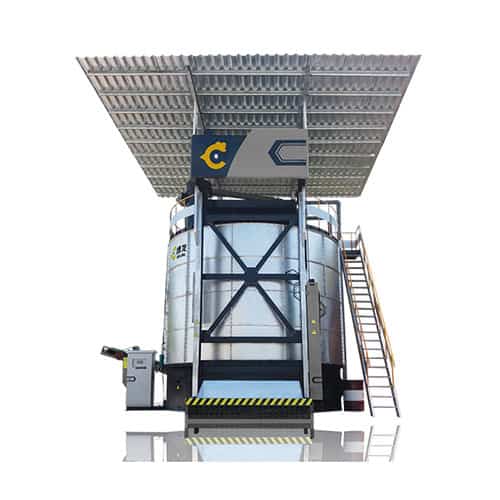
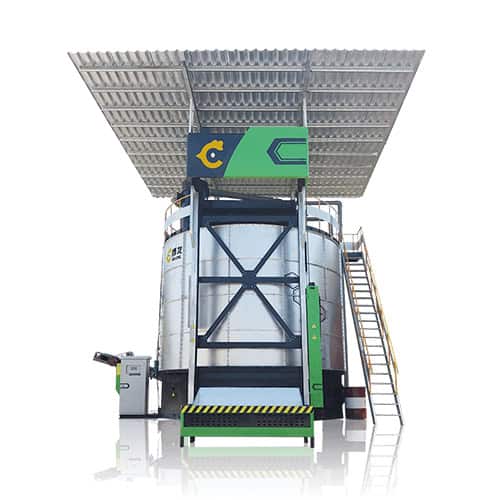
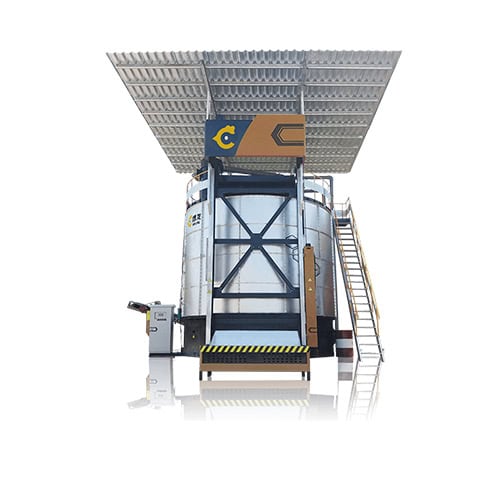
By means of an enclosed animal manure fermenter, the pathway is completely removed and exposure is eliminated. Rain and leachate cannot get into a sealed insulated steel vessel. This is a structural feature of the equipment and not a performance claim based on the type of waste used or climate. For farms near protected streams or groundwater recharge areas, this one feature is often the deciding factor.
Odor has traditionally been livestock farming’s untouchable problem — unpleasant, but nobody’s jurisdiction. That era is ending on two fronts. In Chile, Decreto 9 now expresses odor limits as emission rates that pig operations must not exceed. In countries that have not yet adopted odor-specific standards, enforcement typically begins with neighbor complaints, and once enough complaints accumulate against one farm, the case gets a file and a name.
The weakest position of either system is an open composting yard. It constantly emits odor and wind directs where it will go.
Fermenting inside an animal manure fermenter changes the physics of the problem. The process is sealed, so the baseline odor footprint is dramatically reduced compared to open piles, the smell is no longer drifting across the fence line day and nite. A deodorization system is available where the operation is already the subject of complaints or is situated close to villages and will significantly reduce emissions from the exhaust stream of the animal manure fermenter. This is stated carefully because odor performance depends on feedstock and climate, but it is enclosure plus treatment that measurement-based regulation ultimately rewards.

Raw manure contains fecal coliforms and eggs of parasites. The application of it on forage or crops without treatment is creating a disease pathway. Regulators are asking a direct question: How do you eliminate pathogens before land application?
The old answer of piling it up and waiting is becoming indefensible. A windrow pile may reach temperatures to kill pathogens for an unknown amount of time in an unknown process. If the inspector’s question can be simply answered with “probably,” then the farm has a problem.
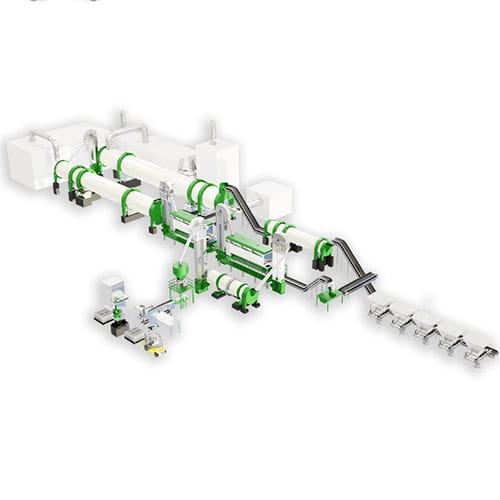
Bolong’s animal manure fermenter offers a different approach because the biology inside the tank is designed, not accidental. High temperature aerobic fermentation is the decomposition of manure with thermophilic microorganisms . The continuous forced-air system allows the necessary oxygen and keeps the temperature over 55°C all the time during the cycle . This is active biological control rather than passive rotting and the results are verified rather than assumed: laboratory testing of the finished product has revealed no trace of fecal coliform, Ascaris eggs or heavy metals – cadmium, lead, chromium, arsenic and mercury – all of which are far below regulatory limits.
All three risks are connected by a deeper issue. Even a disciplined windrow operation that turns piles on schedule and produces acceptable compost cannot prove anything. The process leaves no record of temperature or duration, and there is no way to demonstrate to an inspector or auditor that pathogens have been killed. Good intentions are not evidence.
A modern animal manure fermenter, on the other hand, produces consistent, repeatable results. The process runs under controlled conditions — the same temperatures, aeration and cycle — so the finished product is consistent, unlike windrow compost which varies with the seasons. Furthermore, the finished product can speak for itself: any farm can have it sampled and tested by a third-party laboratory at any time. Verified output from Bolong‘s equipment showed that the levels of organic matter and total nutrients were 52% and 11.9% respectively, exceeding the thresholds of 45% and 5.0% set out in China’s organic fertiliser standard by a clear margin.
With those numbers, output is not waste. It is a sellable organic fertiliser. For operations near poultry clusters, horticultural districts or regions with a high demand for fertiliser, documented product quality transforms a compliance expense into a source of revenue — the same test report that satisfies the inspector can also be used to promote the product in the market.
Another quiet contributor is waste heat recovery, which captures some of the fermentation heat for reuse, thereby lowering the operating costs of running the animal manure fermenter. An investment in compliance that partially funds its own operation is easier to justify.
It is only in the past two years that enclosed fermentation tanks have begun to appear on South American farms in meaningful numbers. Most operations in the region still use open piles. This creates an opportunity: when the next licence renewal or buyer conversation arises, those who have installed an enclosed animal manure fermenter can present a verified test report, while their competitors are still explaining the process from memory.
Farms that install an enclosed animal manure fermenter during this period are not just reacting to enforcement. They are getting ahead of it.
Environmental requirements are enforced country by country, often region by region, so the first step is yours: check what your environmental authority requires of a livestock operation your size — discharge rules, setback distances, odor provisions, and any licensing or registration deadlines that apply. Chile’s Decreto 9 and Bolivia’s licensing system under Ley 1333 are useful reference points for what tightened enforcement looks like in practice.
Once you know the requirement, the next step is a conversation, not a quotation. Tell us your country and region, your current manure handling method, and the timeline you are working against. Our solutions are built around each customer’s situation — manure volume, farm layout, local requirements — so we will recommend the animal manure fermenter configuration that fits your operation. 【Contact us for a solution tailored to your farm】