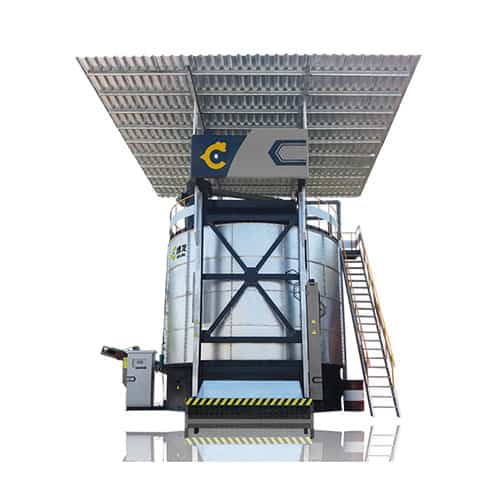
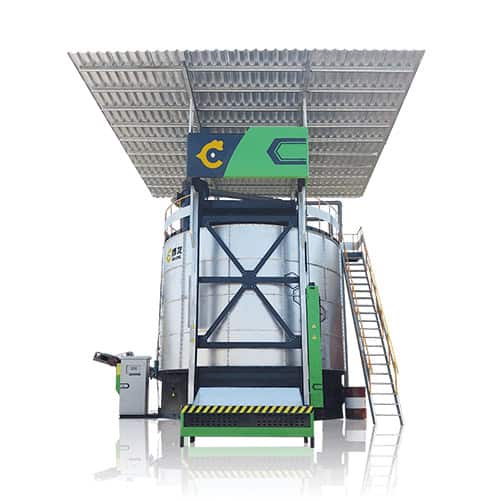
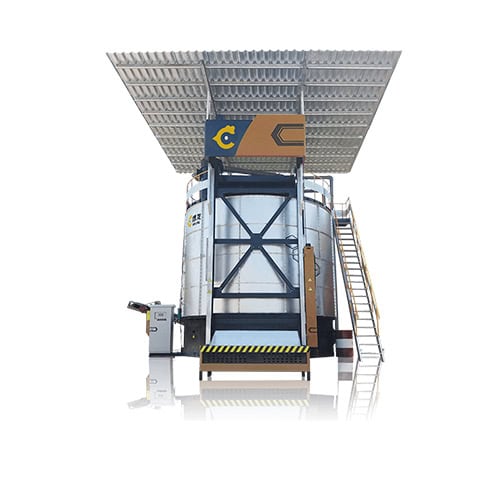
Manure keeps arriving whether the farm has room for another pile or not. Bolong organic fertilizer fermenter gives prepared manure a defined route: it enters an enclosed tank, undergoes high temperature aerobic fermentation, and leaves as solid material intended for organic fertilizer use.
For a farm considering the equipment, the most useful question is what changes after installation. How does the first load move through the tank? When does discharge begin? And how does the machine handle manure that arrives every day?

Bolong’s equipment is a vertical, enclosed fermentation tank. Prepared manure is lifted into the vessel, where mechanical mixing moves the material and forced ventilation supplies air for aerobic activity. Insulation and temperature monitoring help maintain the fermentation environment inside the tank. The equipment can be installed outdoors or beneath a shelter.
These parts work together to solve a farm problem. In an open pile, workers must return to the material to turn it, and conditions can differ across the pile. Inside Bolong’s organic fertilizer fermenter, mixing and airflow are built into the treatment process. Staff load suitable material and monitor the equipment instead of repeatedly rebuilding a compost pile.
The enclosed structure also gives fermentation air a defined exhaust route. If odor control is a particular requirement, Bolong can include an exhaust deodorization system in the proposed configuration. The tank handles fermentation; the optional module treats air drawn from it.
When the tank is first started, its initial load generally needs about 7–10 days before the first discharge. The farm should plan for manure arriving during that period. Bolong helps connect the existing collection route to the tank’s loading point so the equipment can become part of daily work.
After the initial period, the organic fertilizer fermenter can receive prepared manure and discharge processed material each day. The material leaving today entered earlier. Today’s fresh load continues fermenting inside the vessel; it is not finished the next morning.
That daily in, daily out rhythm is the practical advantage for a working farm. Manure no longer has to wait for an entire outdoor pile to finish before the next load can enter treatment. The selected fixed tank model, loading arrangement and discharge route are planned around the farm’s actual manure flow.
A treatment process is only useful if both its entrance and exit work on site. Incoming manure needs a clear route from the houses or receiving point to the loading system. The solid material leaving the tank needs space to be collected, stored or moved to its next use.
Bolong’s organic fertilizer fermenter produces solid output intended for organic fertilizer use. A farm may plan to use that material on its own land or send it for further fertilizer processing, depending on its project and applicable requirements. Bolong can provide available output test information to support discussions about the intended use; the farm’s actual material should be assessed for its destination.
This is why Bolong discusses more than the vessel itself. The team can help select an appropriate fixed model and plan the loading and discharge arrangement around it. Materials, insulation and supporting modules can be specified for the installation, while the equipment’s daily treatment capability remains tied to the chosen model.
A fattening pig farm in the Philippines purchased a Bolong 11FFG-102 tank to process pig manure and produce material for organic fertilizer. The farm was using this type of equipment for the first time, so its operators needed to learn how the manure should be prepared, loaded and managed during initial fermentation.
Bolong engineers provided operating demonstrations and guidance during startup. Once the team understood the equipment’s routine, the organic fertilizer fermenter became part of the farm’s manure treatment process. The case illustrates an important point for buyers: the product’s value comes from how its enclosed fermentation and daily operation fit the farm’s real work, supported by a clear handover to the people running it.
Bolong provides installation, commissioning and operator training to help customers put the equipment into use. Those services support the tank’s operation; the core solution remains the enclosed aerobic treatment of manure.
1、Does the tank produce fertilizer on the first day?
No. The first load needs an initial fermentation period before discharge begins. After startup, processed material can leave while new prepared manure enters each day.
2、Can the tank be installed outside?
Yes. Bolong’s vertical tank provides the fermentation environment within its enclosed, insulated vessel. It may be installed outdoors or beneath a shelter, subject to the project’s site arrangement.
3、Can an organic fertilizer fermenter receive any manure without preparation?
Incoming moisture and material condition matter. Bolong can assess the farm’s manure and recommend preparation where needed before feeding the selected model.
The first discharge is only the beginning. The lasting benefit is a repeatable route from manure collection to enclosed treatment and solid output—one that can continue as new manure arrives.
If you are considering a Bolong organic fertilizer fermenter, contact our team for the fixed-model options, a proposed loading and discharge layout, and a running video showing how the equipment works from first feeding through daily operation.