Today, Brazil imports 87.3% of its fertilizer. The National Fertiliser Plan (PNF) approved in 2023 aims to reduce this dependence to 34.9% by 2050, meeting 45-50% of domestic demand through local production. This is not merely an abstraction in policy for the nation’s livestock producers. This is a clear message that the manure piling up behind their barns is no longer just a disposal problem. The country needs this resource.
The PNF is not just after mining companies and chemical plants. It explicitly promotes the production of organic and bio-based fertilisers as part of the import substitution strategy. Brazil is the world’s top poultry exporter and fourth largest pork producer. This means millions of tonnes of manure are produced every year – which can be converted into high-grade organic fertiliser and replace some of the imported NPK if properly processed.
The problem has always been the mode of processing. The traditional method of composting takes between 60 and 90 days, requires large areas of land, creates strong odours as well as inconsistent quality. In the tropical climate of Brazil, these limitations are compounded for commercial-scale farms by the heat and humidity that accelerate pathogen growth and odour production during open composting.
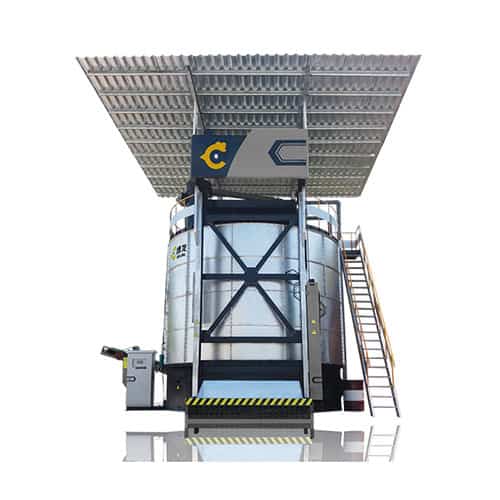
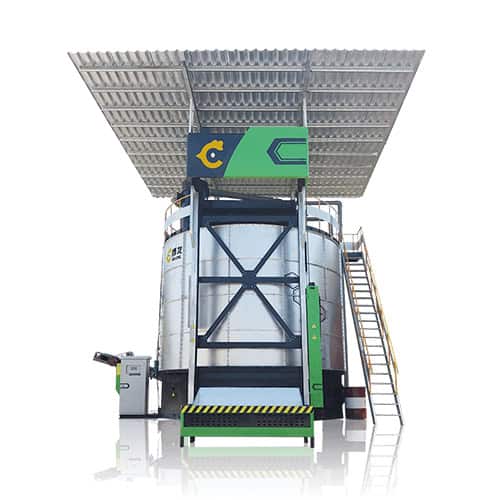
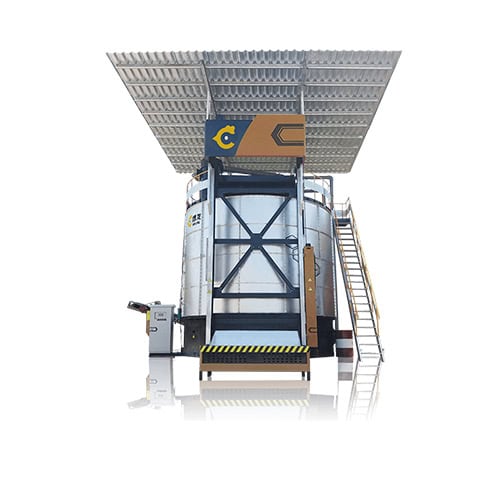
An organic fertilizer fermentation system changes this equation. Rather than taking months of open-air composting, the system uses enclosed, high-temperature, aerobic fermentation to convert fresh manure into finished organic fertiliser in around 7 days.

The basic principle is controlled aerobic fermentation at high temperature. This is what happens in the tank:
Loading: Fresh livestock manure (from chickens, pigs or cattle) is loaded into the sealed fermentation tank and mixed with auxiliary materials, if necessary to adjust the carbon to nitrogen ratio.
Heating: The system heats up and keeps the internal temperature at about 55°C. This critical high temperature phase kills pathogens, weed seeds and parasite eggs, while speeding microbial decomposition.
Fermentation: Aerobic bacteria rapidly decompose organic matter. The design enclosed maintains a constant temperature, oxygen supply and moisture level, regardless of the weather conditions outside—a major advantage in Brazil’s variable climate zones.
Discharge: After approximately seven days, the processed material exits as mature organic fertiliser. Testing data from Bolong’s fermentation systems shows the following:
Organic matter content: 52% (standard ≥45%)
Total nutrients (N+P₂O₅+K₂O): 11.9% (standard ≥5.0%)
Moisture content: 22% (standard ≤30%)
Faecal coliform: negative
Roundworm eggs: undetected
A waste heat recovery system captures thermal energy from the process, reducing the organic fertilizer fermentation system’s overall energy consumption.
The maths are straightforward. Brazil has spent over $24 billion on fertiliser imports in recent years. Every tonne of organic fertiliser produced on-site from manure means one less tonne that a farmer needs to buy – or one more tonne that they can sell.
There are three main benefits to Brazilian livestock operations from an organic fertilizer fermentation system:
Speed: 7 days, instead of the traditional 60 to 90 days composting. It means faster turnaround, smaller footprint and more manure processed with the same equipment.
Consistent quality: Fermentation in an enclosed environment with temperature control yields consistent batches. But good open composting depends on the weather, on the frequency of turning and on the expertise of the operator. The PNF’s push for quality standards means consistency is more important than ever, with buyers and regulators demanding predictable nutrient content.
Labour efficiency: A single operator can manage the system, compared to the 4-5 workers needed for manual composting operations. For large-scale poultry and swine farms in Brazil, this labour reduction directly improves the bottom line.
Brazil’s tropical and subtropical climate actually aids the fermentation process. Ambient warmth reduces the energy required to reach and maintain the target temperature of 55°C. The organic fertilizer fermentation system performs well in all of Brazil’s climate zones – from the rainy south (Santa Catarina, Paraná) to the hot northeast (Bahia, Pernambuco) and the central states (Mato Grosso, Goiás) where poultry and swine production is concentrated.
Under CONAMA, Brazilian environmental regulations impose requirements for waste management at livestock facilities. Manure storage and composting generate many odor complaints . Open manure storage and composting are especially odiferous . This will be an increasing problem as residential development encroaches on agricultural areas.
The organic fertilizer fermentation system is enclosed, which greatly reduces odor. The sealed design prevents emissions from escaping, and the integrated deodorization system prevents odor from escaping to the immediate tank area. The goal isn’t to remove all hint of smell, but to reduce odor to a level that does not elicit complaints or regulatory scrutiny.
1、How much manure can an organic fertilizer fermentation system process?
Bolong offers 8 standard tank models ranging from 102m³ to 280m³ in volume, covering operations from mid-size farms (e.g., 20,000+ layer hens or 500+ finishing pigs) to large commercial facilities.
2、Does the system work with mixed manure types?
Yes. The organic fertilizer fermentation system handles chicken, pig, and cattle manure. Carbon-to-nitrogen ratios can be adjusted with auxiliary materials like crop straw or sawdust.
3、What about the output quality for Brazilian standards?
Tested output from the organic fertilizer fermentation system shows organic matter at 52%, total nutrients at 11.9%, moisture at 22%, with fecal coliform negative and heavy metals far below Brazilian and international limits -suitable for both direct field application and commercial organic fertilizer registration.
Brazil’s fertilizer independence starts at the farm gate. Tell us your operation size and manure type – we’ll match you with the right tank model and estimate your daily fertilizer output.