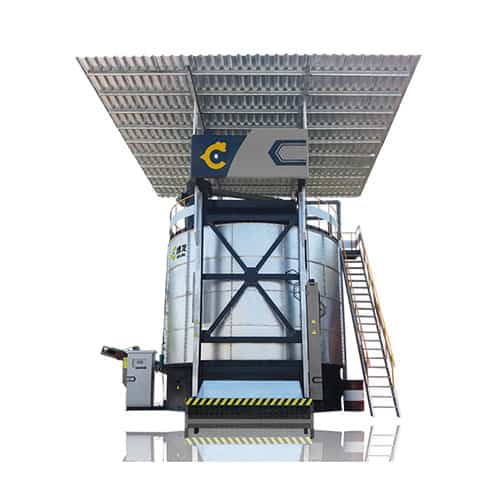
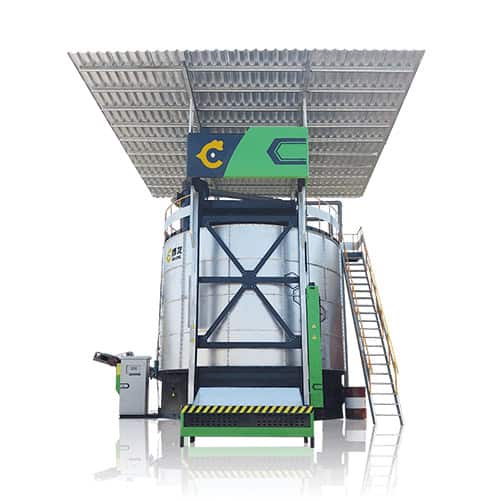
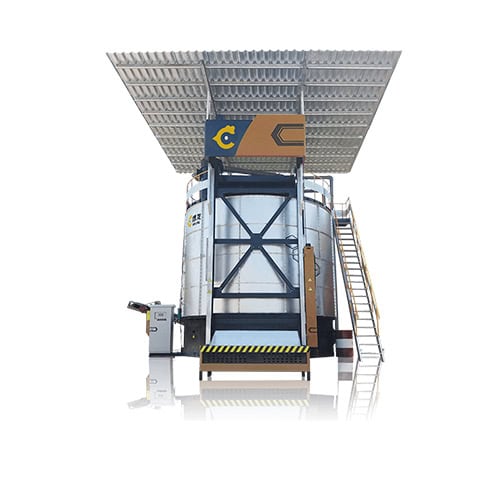
The choice between tank designs usually gets made in a catalog. It is better made on the plot. Before you compare features, walk the site where the tank would stand: how much ground is free, how high you can build, how manure arrives, and how close the neighbors are. For most farms, those answers point toward a vertical manure fermentation tank, and it helps to see why.
The difference is in how the manure moves. A horizontal design is a vessel lying on its side, and the material travels along its length while it ferments. A vertical design stands upright, and the material moves from the top of the tank to the bottom.
Both are enclosed, and both aim at the same result: manure treated under controlled conditions instead of in an open pile. What differs is how each one uses the site. A horizontal vessel needs a long, flat stretch of ground. A vertical one needs only a compact base.

It saves ground. Because the vessel stands upright, the footprint is small, which matters when land is already taken by barns, storage, and access roads. On many farms, ground is scarcer than height.
Loading and discharge are simple. Manure goes into a hopper, a hydraulic lift carries it to the top of the tank, and it is tipped in. Finished organic fertilizer is recovered at the bottom of the tank every day. Material moves through the vessel, so the process runs as a daily routine of manure in and fertilizer out, about 7 days on average from waste to fertilizer.
The process stays sealed. A vertical manure fermentation tank is enclosed, and its exhaust passes through a deodorizing system before it leaves the site. A heat exchanger reuses the heat from the exhaust air to warm the air going in, so the tank operates in regions with very low temperatures as well as high humidity.
It runs on automatic control. An automatic control system manages the process, so nobody has to turn piles or monitor temperatures by hand.
This is the design behind Bolong high temperature aerobic fermentation tank, and it is the only shape we build.
A horizontal design asks for length: a long, level site, and room at both ends for manure to enter and fertilizer to leave. If your plot is compact or already crowded, that length is hard to find.
A vertical manure fermentation tank asks for something different: vertical clearance. So the main check is whether your site has a height limit. If it does not, which is the case on many farms, an upright tank usually fits more easily than a long vessel lying down.
How much ground is free, and what shape is it? A compact square suits a vertical manure fermentation tank. A long strip is what a horizontal vessel needs.
How high can you build? Check local height limits and what stands nearby.
How does manure arrive? By scraper, belt, or loader? A hopper with a hydraulic lift connects easily to a loader or a conveyor.
How much manure, now and later? Daily volume sets the size, and growth plans decide whether you need room for a second tank.
Who lives nearby, and what is the climate? Your neighbors and your coldest week both make a sealed design with exhaust treatment worth more.
Manure at 65% moisture or below generally suits a vertical manure fermentation tank, and wetter material may need its moisture reduced first, depending on its condition. It treats poultry, pig, and cattle manure alike. And the fertilizer that comes out every day is worth planning for early, so the daily routine runs smoothly from the first week.
Is a vertical manure fermentation tank better than a horizontal one? For most farm sites, a vertical design is the more practical choice because it saves ground and handles loading and discharge in one flow. The main thing to check is your height limit.
1、Does a vertical manure fermentation tank need a lot of height?
It needs more height than a tank lying on its side, so tell us your site’s height limits and ground conditions when you inquire.
2、Is it hard to load a vertical manure fermentation tank?
No. Manure goes into a hopper, and a hydraulic lift carries it to the top of the tank and tips it in. Finished organic fertilizer is recovered at the bottom, so loading and collecting both happen from one structure.
3、What should I send to get advice?
A photo or rough sketch of the plot, your daily manure volume, its moisture level, and the climate at your site.
Before choosing a tank, look at where it would stand. Send us a photo or a rough sketch of your site through the contact page, along with your daily volume and moisture level, and Bolong will help you judge how a vertical manure fermentation tank fits.