Ask three farmers how long manure needs to sit before it is safe to spread, and you will get three different answers. Six months, maybe a year. Thirty to sixty days if you turn it regularly. Or seven days, if they run an animal manure fermenter. All three answers are correct — because each belongs to a different generation of manure processing technology, and each generation runs the same biology at a different speed.
The method you choose does not change what happens inside decomposing manure. Microbes break down organic matter, generate heat, kill pathogens, and stabilize nutrients — every time, regardless of equipment. What the method changes is how fast that sequence is allowed to run. And the difference between “let it sit for a season” and “finished in a week” is not patience. It is engineering.
The oldest method is also the slowest. Raw manure is heaped in a static pile and left to sit. Without turning or insulation, only the outer layers are reached by oxygen. The interior becomes anaerobic, the decomposition process slows down considerably, and the pile relies entirely on the ambient temperature to warm up. In summer, the centre may heat up adequately for a few weeks. In winter, the process stops almost entirely. It takes six to twelve months for the material to become stable enough to spread with confidence.
The second generation introduced machinery. Windrow composting involves arranging manure in long rows and turning them on a schedule with a tractor-pulled turner. Each pass injects fresh oxygen and restarts microbial activity. This improvement is significant: a month or two replaces the better part of a year. However, every turn also releases heat into the atmosphere. The pile warms up, cools down, and warms up again. Rain soaks the rows and drops the temperature further. This process is still subject to the weather.
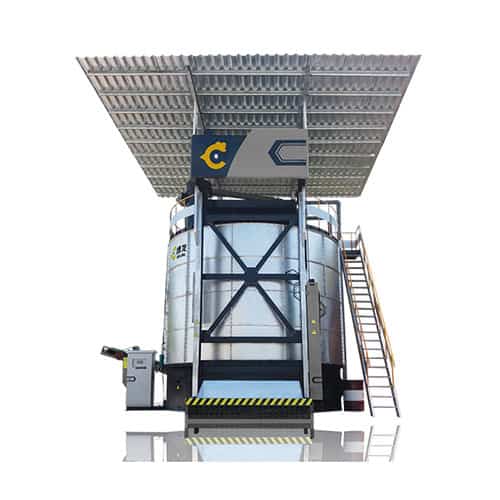
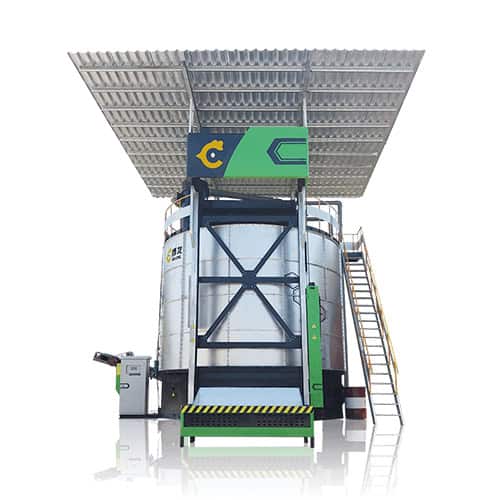
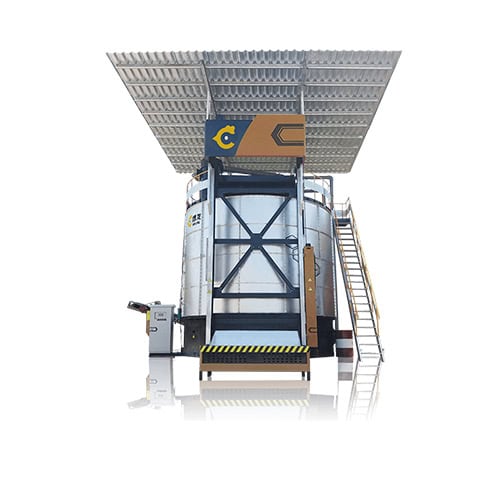
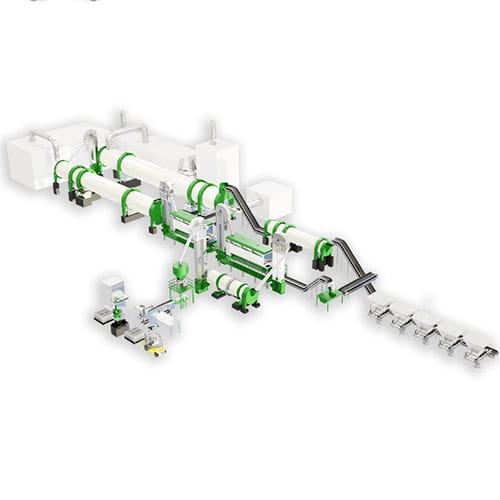
The third generation enclosed the process itself, rather than the building around it. An animal manure fermenter runs the same biological sequence inside a sealed, insulated tank that can be placed outdoors under a shed roof or wherever the site allows; this makes no difference to the biology inside. Temperature and airflow are managed by the vessel itself, rather than being left to the weather. The process takes a week to ten days from start to finish, and on the day one batch is emptied, the next one is loaded. The upgrade does not involve different chemistry. It is the same chemistry, no longer affected by the environment.

To understand why the timelines differ so sharply, consider the various stages that every batch of fertilizer undergoes.
The first stage is mesophilic. Microbes that are active at moderate temperatures begin to consume the most readily available carbon, and their metabolism generates heat. In an open pile, this stage alone can take weeks because the temperature is repeatedly reset by cold nights and rain before the material can progress.
The second stage is thermophilic. As the material heats up to over 45°C, heat-loving microbes take over and the decomposition process speeds up significantly. This is the critical phase, where pathogens die, weed seeds lose viability and volatile compounds break down. The temperature threshold is not arbitrary; sustained heat in this range causes pathogen cells to rupture and renders weed seed embryos non-viable. Below this threshold, the material can decompose perfectly well yet still carry hazards into the field. Speed and safety are related variables — which is why the method that reaches the required temperature fastest also produces the safest output.
In a windrow, the thermophilic phase cycles on and off with every turn and every cold night. In an animal manure fermenter, the insulated vessel and controlled airflow bring the material into this temperature range within the first day or two, holding it there without interruption.
The final stage is curing. The material cools, microbial diversity recovers and the remaining organic matter settles into stable humic compounds. In an open pile, this stage takes up most of the time — months of slow settling while the pile waits for the biological processes started in the earlier stages to finish. In a controlled vessel, however, the sustained thermophilic phase has already carried out most of the decomposition, meaning that the curing requirement is largely met by the time the cycle ends.
The pattern across both traditional methods is the same: the equipment relinquishes control of the temperature, which then dictates the pace of biological processes.
A static pile has no heat source other than its own microbial activity and no insulation to retain heat. Every cold night is a step backwards. A windrow fares better because its larger mass retains more warmth, but every turn — the very act that supplies oxygen — releases heat into the air. The operator is caught between two requirements: oxygen needs to be supplied by turning, but heat needs stillness. Traditional methods alternate between the two and lose time with every transition.
Add weather to the equation and the loss compounds. Rain cools the pile and fills the air pockets that carry oxygen with water. Frozen ground can stop the process entirely for weeks at a time. A windrow schedule quoted in ideal conditions can be considerably longer during a cold or wet season. None of this is a flaw in the biology. It is a flaw in the container — a flaw that an animal manure fermenter is designed to eliminate.
Like every other agricultural process, composting technology has evolved from open to enclosed, from seasonal to continuous and from weather-dependent to controlled.
The static pile is the original method – it is effective in the long term, but treats time as a free resource. Windrow turning was the first mechanical upgrade, dramatically reducing the timeline but still leaving the process outdoors and at the mercy of the weather. The enclosed animal manure fermenter is the latest step in this evolutionary process – the most recent method in a line of improvements dating back to when farmers first started managing manure.
What makes this an improvement rather than a replacement is that the underlying biology has never changed. Farmers have always relied on the same microbes to perform the same work at the same temperatures. The vessel simply removes the obstacles slowing down those microbes: heat loss, oxygen starvation, weather exposure and seasonal shutdown.
Inside the tank, insulation retains the heat that a windrow releases with every turn. Controlled airflow delivers oxygen continuously rather than in bursts. Auxiliary heating and heat recovery maintain the thermophilic range, regardless of external conditions. The microbes operate at their optimal speed – not faster, as the biology has a limit, but also not slower.
The compressed timeline has a greater impact than just the calendar. It alters the way the operation works.
With a batch-and-wait system, manure accumulates while earlier batches are finished off. Storage lagoons and stockpile pads are necessary because the process cannot keep up with the rate at which the animals produce the raw material. In contrast, continuous processing inverts this relationship: today’s manure enters the vessel and last week’s leaves as finished fertiliser. Nothing sits. Nothing accumulates. The storage problem that dominates traditional manure management is reduced to almost nothing.
The same logic applies to the footprint. Piles and windrows occupy ground for the full duration of their cycle, meaning the same acreage can only process a few batches per year. However, an animal manure fermenter works vertically and continuously, meaning that the land not spent on decomposing stockpiles can be used for other purposes.
The schedule also becomes predictable. When the output is ready at regular intervals, fertiliser application becomes proactive. Fields receive product when the crop needs it, rather than when the pile finally finishes. In climates with real winters, this difference is significant — it means the difference between a manure system that runs year-round and one that shuts down for a quarter of the year.
Here is a simple exercise. Look at today’s date and count back six months. If you had built up a static pile of manure then, it would now be at a stage where it is safe to spread. Now count back a week. This is the entire processing time required by an animal manure fermenter to deliver the same result: pathogen-free, nutrient-stable, field-ready manure.
The six-month pile answers the question of what to do with manure in the long term. The animal manure fermenter provides a solution for this week. Tell us your daily manure volume and how you handle it now.