For farms relying on traditional composting, the calendar matters almost as much as the manure itself. Cold winters slow everything down. Heavy rain ruins a pile’s consistency. What should be a predictable process becomes something that depends on the weather cooperating — and when it doesn’t, the fertilizer output that farms count on either shrinks or disappears for weeks at a time.
A properly designed manure composting tank removes that dependency entirely, which matters for more than convenience — it’s what determines whether the organic fertilizer coming out the other end is something you can actually rely on and build value around.
Without a manure composting tank, most farms rely on open piles and windrow composting, which depend entirely on favourable outdoor conditions. Cold temperatures dramatically slow down microbial activity, often extending the normal 45–60 day cycle even further during the winter months. Heavy rain can saturate the piles, disrupting the moisture balance needed for proper decomposition and increasing odour and runoff issues. In humid climates, excess moisture can slow down the breakdown process just as much as cold weather can.
The result is a process that performs differently every season — reliable in good weather and unreliable when conditions turn against it.
Unpredictable output is more than just an operational inconvenience — it directly limits what a farm can do with its fertiliser. If output drops or stops for weeks in winter or the rainy season, farms cannot rely on a consistent supply for their own use, let alone consider selling surplus fertiliser to generate additional revenue. Buyers and neighbouring farms won’t establish a purchasing relationship with a supplier whose output disappears for part of the year.
In other words, inconsistent composting not only slows down waste processing, it also caps the value that manure can ever reach — a gap that a manure composting tank is designed to close.

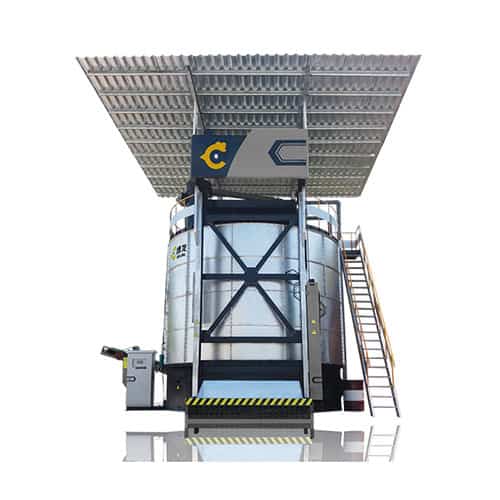
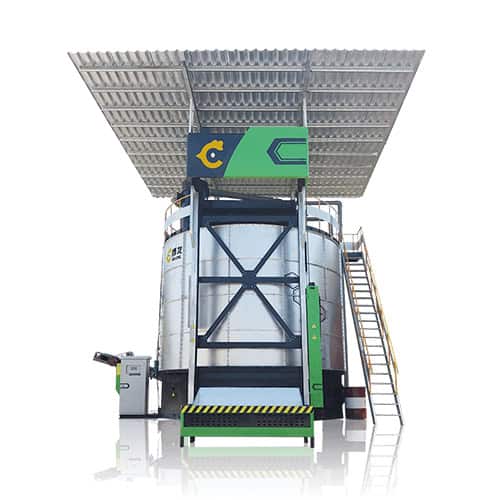
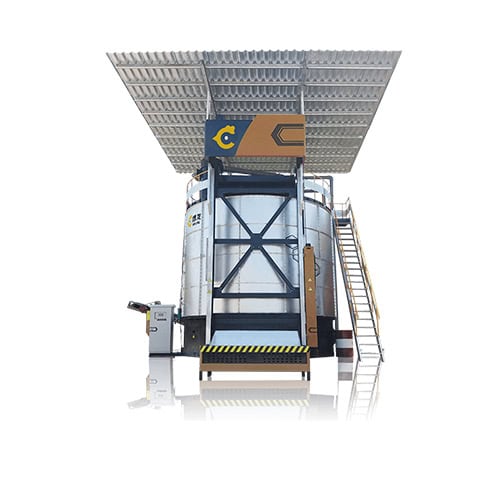
Bolong’s manure composting tank, the High Temperature Aerobic Compost Tank, is a fully enclosed, vertical system designed to eliminate the impact of external conditions.
The heat exchanger captures exhaust heat from the fermentation process and uses it to warm incoming air, maintaining the high internal temperature that aerobic fermentation needs, even through cold winters that would cause an open pile to stall.
The fully sealed structure means that rain, humidity and outdoor temperature fluctuations never reach the material inside, so conditions remain stable regardless of the season or region.
The tank processes manure into finished compost in about a week, every week, thanks to its continuous 7-day cycle. This is because internal conditions stay consistent, rather than speeding up in summer and stalling in winter.
This is the difference between a process that works ‘when conditions are right’ and one that is engineered to work regardless of the conditions.
If a manure composting tank maintains consistent processes, the end product will be consistent too. Every batch undergoes the same high-temperature aerobic conditions, which means:
Consistent quality: no more “good batches” and “bad batches” depending on the season
Consistent volume: a predictable amount of finished compost every seven days, year-round
Consistent biosecurity: the same high-temperature process reliably breaks down pathogens in every cycle, not just under ideal outdoor conditions
This consistency turns organic fertiliser from something you hope is usable into something you can actually plan around.
A steady, predictable supply of organic fertiliser from a manure composting tank opens up options that inconsistent composting never allows.
Reliable volume for your own land, without gaps during winter or wet seasons
The option to sell surplus fertiliser, since consistent quality and supply are what buyers look for when deciding whether to commit to a purchasing relationship
No seasonal dead periods, meaning fertiliser production — and any revenue tied to it — doesn’t pause for months at a time
For farms trying to turn manure management from a cost centre into even a modest income source, this kind of consistency isn’t just desirable — it’s essential. It’s the baseline requirement.
This isn’t a theoretical advantage. Bolong manure composting tanks currently operate on farms across Vietnam, Russia, Spain, Malaysia, the USA, and numerous provinces across China — spanning humid tropical regions, temperate climates, and cold winters alike. The same enclosed design and heat recovery system that stabilizes performance in one climate is what makes it reliable in all of them.
1、Does cold weather really stop manure composting from working?
Yes, in open piles and windrow systems, cold temperatures significantly slow microbial activity, often extending composting time well beyond the normal cycle or halting it almost entirely during winter. Enclosed tanks with heat recovery avoid this by maintaining internal temperature independently of outside conditions.
2、Can a manure composting tank work well in high-humidity or tropical climates?
Yes. Because the tank is fully sealed, external humidity and rainfall don’t affect the internal composting environment, unlike open piles where excess moisture can disrupt the process.
3、Is fertilizer from a manure composting tank consistent enough to sell to other farms?
Consistent processing conditions produce consistent output quality, which is a key requirement for farms considering selling surplus organic fertilizer rather than only using it internally. Reliable, year-round supply is what makes that possible.
If your composting output rises and falls with the seasons, your farm is leaving both efficiency and potential revenue on the table. Contact Bolong to discuss a manure composting tank built to perform consistently in your region’s climate.