For poultry farm owners, manure is no longer something to hide; it is an increasing cost. As labour becomes harder to find and environmental regulations become more stringent, more and more farms are considering the livestock and poultry manure fermentation tank to be the practical solution to both issues.
This article explains why such a tank has become the go-to investment for medium and large-scale poultry operations, and what to look for when choosing one.
Although traditional open composting works in theory, it is difficult to implement on working farms. Manure is left in the open for 60-90 days, which results in the release of ammonia, the attraction of flies, and the production of inconsistent compost. Workers turn the piles by hand or with small machines, and during heavy rain, leachate can run off into drainage ditches and waterways.
For a 50,000-bird layer farm, these daily issues can quickly become overwhelming. Labour costs rise, neighbour complaints increase, and the compost produced is often too low grade to sell. A livestock and poultry manure fermentation tank addresses all three issues simultaneously: the tank seals the process inside, accelerates fermentation and produces a consistent organic fertiliser in days rather than months.

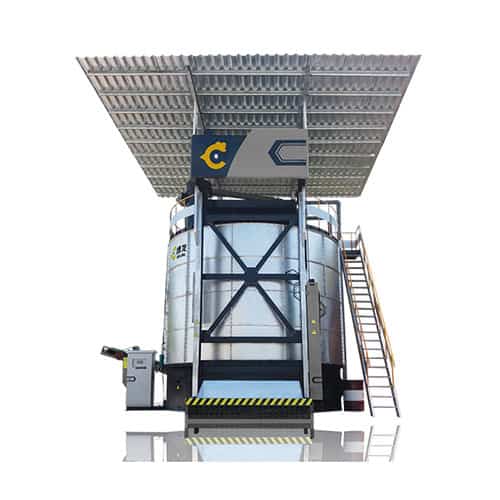
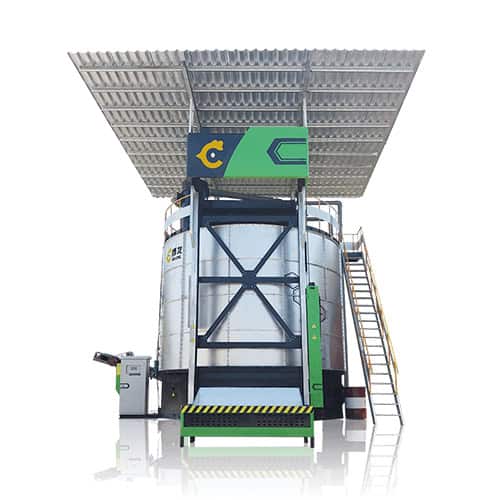
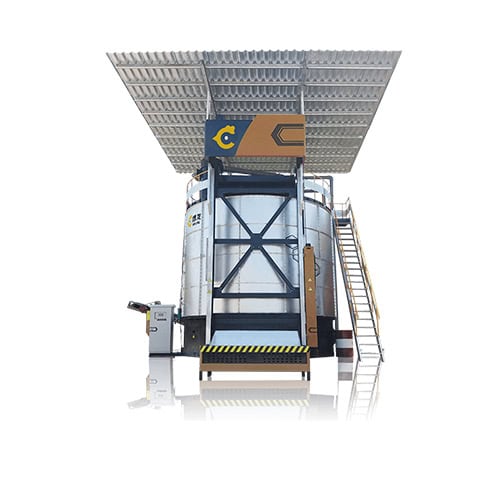
The fully enclosed livestock and poultry manure fermentation tank controls the temperature, oxygen and moisture levels. Manure is loaded from the top and mixed by an internal agitation system. It is then exposed to controlled heating, which drives aerobic microbial activity.
Within 24-48 hours, the internal temperature climbs to 55 °C and remains at this level for long enough to kill pathogens, parasites and weed seeds. By day 7, the material has fully matured into stable, low-odour organic fertiliser, ready for bagging, field application or sale.
As the tank is sealed, no rainwater enters and no leachate escapes, keeping the surrounding air clean. The livestock and poultry manure fermentation tank performs the function of an entire composting yard within a footprint small enough to fit next to a single poultry house.
Three things separate a useful tank from a frustrating one:
Material adaptability. The livestock and poultry manure fermentation tank should handle chicken manure, duck manure, goose manure, and other livestock waste without forcing you to add bulking agents. Bolong‘s tank accepts chicken manure at moisture content below 65% directly, with no supplementary material required.
Discharge quality. Ask the manufacturer for third-party test data. Bolong’s livestock and poultry manure fermentation tank produces organic matter at 52%, total nutrients (N+P₂O₅+K₂O) at 11.9%, fecal coliform negative, and heavy metals well below national standard limits.
Daily operation cost. A well-designed livestock and poultry manure fermentation tank should run with one operator instead of the 3-5 workers required for open composting. Bolong’s waste heat recovery system captures heat from exhaust air and reuses it to reduce heating energy consumption over the fermentation cycle. Combined with the 7-10 day cycle, this means less material in inventory, less odor on the farm, and faster cash flow if the fertilizer is sold.
1、How long does one batch take in a livestock and poultry manure fermentation tank?
Bolong’s standard cycle is 7-10 days from loading to discharge-ready fertilizer. Compared to the 60-90 days of open composting, the livestock and poultry manure fermentation tank delivers usable fertilizer roughly 8-10 times faster.
2、What size tank does a 50,000-bird layer farm need?
Tank size depends on daily manure output and target cycle time. Bolong offers a variety of models from 102 m³ to 280 m³, and can also configure multiple tanks in parallel for very large operations.
3、Does the tank create odor problems for nearby homes?
No. The sealed livestock and poultry manure fermentation tank includes a deodorization system that treats exhaust air before release, which is why Bolong tanks are commonly used on farms located near residential areas.
The livestock and poultry manure fermentation tank transforms daily waste into a finished product that your farm can use or sell. For poultry farms looking to reduce labour costs, comply with environmental regulations and produce a saleable by-product, the investment pays for itself within the first two to three years of operation.
Bolong’s manure fermentation tanks are currently exported to over 30 countries and have a proven track record of performance across different climate zones and farm scales.
Contact Bolong today to discuss which tank is right for your farm.