Ask a farm owner what their animal manure fermentation tank does, and most will say “it makes fertilizer.” That answer is not wrong – but it skips the part that matters. Between loading raw manure and discharging finished fertilizer, the tank is killing pathogens, stabilizing nitrogen, eliminating odor, and compressing a 90-day process into 7 days.
Understanding what actually happens inside an animal manure fermentation tank is the difference between buying equipment that works and buying equipment that just sits there. This article walks through the process – what goes in, what happens inside, and what comes out.
Most farms handle manure by stockpiling it. Piles grow in the corner of the property, sometimes for months, until someone has time to spread them on fields. The problems with this approach are well known: smell, leachate, flies, and inconsistent application of partially decomposed material.
An animal manure fermentation tank takes a different approach. Instead of letting manure decompose slowly and unevenly in the open, the tank creates the ideal conditions for fast, complete, pathogen-free composting. The result is a finished organic fertilizer in 7-10 days, with no leachate, minimal odor, and a consistent nutrient profile.

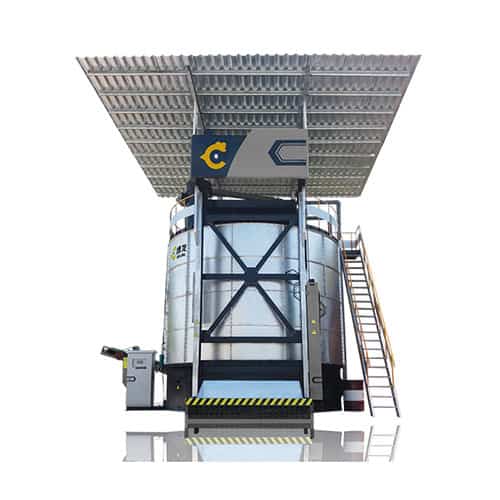
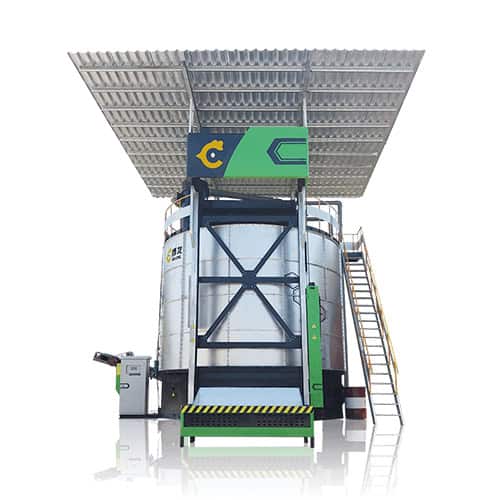
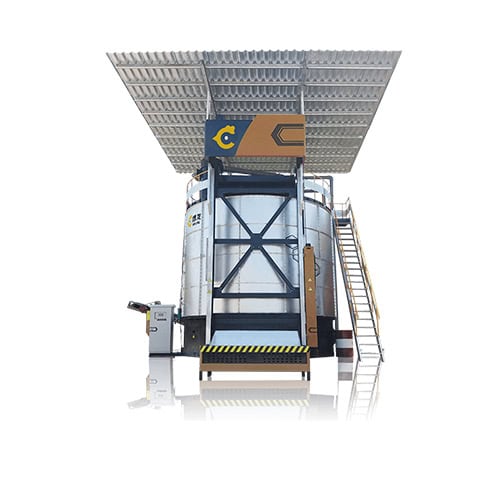
The animal manure fermentation tank is a sealed and insulated vessel equipped with a mechanical mixing system, forced aeration and temperature control. Manure is loaded into the tank and mixed and aerated automatically.
Within hours, the contents are heated to 55°C by microbial activity, and this temperature is maintained for the duration of the cycle. This temperature is high enough to kill pathogens, parasites and weed seeds, yet low enough to preserve beneficial microbial activity. The tank’s deodorisation system treats exhaust air so that no untreated odour leaves the building.
After about a week, the result is a stable organic fertiliser that can be bagged, sold or applied directly to fields. The animal manure fermentation tank transforms waste into a valuable resource.
An animal manure fermentation tank is a good fit for:
For smaller operations, the capital cost may not justify the throughput. But for any farm producing commercial volumes of manure, the animal manure fermentation tank is increasingly the standard solution.
The three most important things are:
1、Material adaptability. The animal manure fermentation tank should be able to handle manure from chickens, ducks, pigs and cattle without you having to add bulking agents. Bolong’s tank can accept chicken manure with a moisture content below 65% directly, with no supplementary material required.
2、Discharge quality. Ask for third-party test data. The Bolong animal manure fermentation tank produces 52% organic matter, 11.9% total nutrients (N+P₂O₅+K₂O), is free from faecal coliform and has heavy metal levels well below national standard limits.
3、Operating simplicity. A good animal manure fermentation tank can be operated by one person with basic training. Look for automatic control, fault alarms, and standard electrical connections.
How much manure can one animal manure fermentation tank hold?
Bolong‘s standard models range in size from 102 to 280 m³. The exact model required depends on your daily manure output and available space. Bolong’s technical team can recommend the right tank size for your operation.
Do animal manure fermentation tanks smell?
The sealed tank is equipped with a deodorisation system on the exhaust. During normal operation, odour is significantly reduced and contained within the immediate tank area rather than spreading to the surrounding neighbourhood.
Is the finished compost safe to use on crops?
Yes. The high-temperature cycle in the tank kills pathogens, parasites and weed seeds. The resulting compost meets organic fertiliser standards and can be applied directly to fields, sold to farmers or packaged for retail sale.
Contact Bolong to discuss installing an animal manure fermentation tank in your operation.