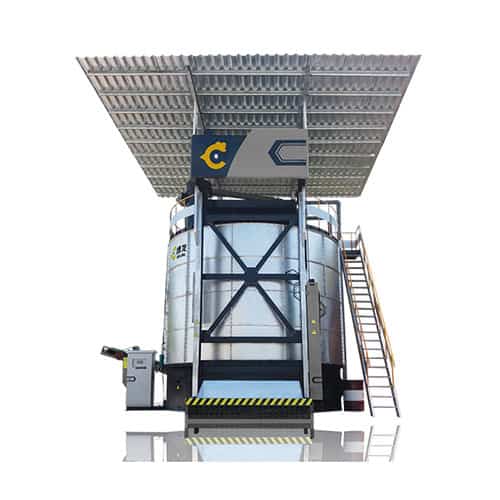
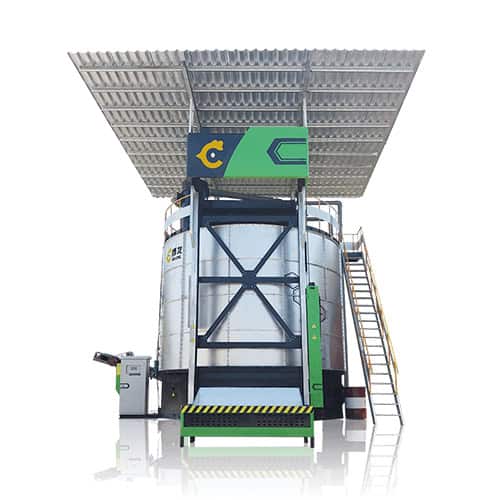
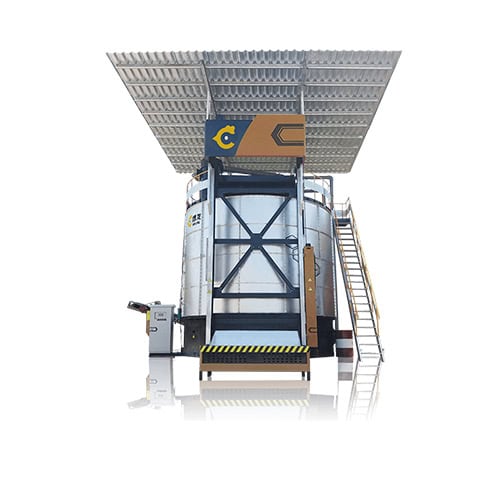
Traditional open-air composting takes between 60 and 90 days to convert livestock and poultry manure into usable organic fertiliser. However, an animal manure fermentation tank can complete the same process in just seven days. What accounts for this significant difference?
The answer lies in three scientifically controlled fermentation stages, each of which relies on precise temperature management within a sealed container. This article will explain the scientific principles behind high-temperature aerobic fermentation in detail.
High-temperature aerobic fermentation is a biological decomposition process in which microorganisms break down organic matter in an oxygen-rich environment at temperatures ranging from 50°C to 70°C. This differs fundamentally from anaerobic digestion, which produces biogas. Aerobic fermentation requires a continuous supply of oxygen and yields heat, water vapour, carbon dioxide and stable organic fertiliser. When properly managed, this process produces virtually no odour.
It is suitable for various types of livestock and poultry waste, including chicken manure, pig manure, cow manure and sheep manure. The final product is a nutrient-rich, pathogen-free organic fertiliser that generally meets international export standards when properly processed in professional-grade animal manure fermentation tanks.
The temperature curve is the same for every animal manure fermentation tank. Understanding this curve enables operators to diagnose issues and optimise operational performance.

Within the first 24 to 48 hours after manure is loaded into the fermentation tank, mesophilic microorganisms become active. These microorganisms break down easily degradable organic matter, such as sugars and starches. This process releases large amounts of heat, causing the temperature of the pile to rise rapidly to around 40°C.
The success of this stage depends on two key factors:
Moisture content: The ideal range is 50–60%. If the material is too dry, microbial activity stalls. If it is too wet, oxygen cannot penetrate, creating anaerobic zones and producing foul odours.
The carbon-to-nitrogen ratio (C/N): The optimal range is 25:1 to 30:1. Pure chicken manure has an approximate C/N ratio of 10:1 and therefore requires the addition of regulators, such as wood shavings or rice husks, before being loaded into the animal manure fermentation tank.

This is the most critical stage in the entire process. Once the temperature exceeds 50°C, thermophilic bacteria replace mesophilic microorganisms and the decomposition rate accelerates dramatically.
Pathogen inactivation: After maintaining a temperature of 55°C or higher for 72 consecutive hours, harmful microorganisms such as Salmonella, E. coli O157:H7 and Ascaris eggs are reliably eliminated. The US EPA has established this as the gold standard for sludge treatment in Regulation 40 CFR Part 503. A properly operating animal manure fermentation tank typically reaches peak temperatures of 60–65°C, with some high-efficiency models exceeding 70°C—well above the minimum requirement.
Rapid decomposition of organic matter: Complex components such as cellulose and hemicellulose decompose more rapidly, reducing the volume by 30–40% and prompting the formation of dark humus.
The sealed design of the animal manure fermentation tank plays a decisive role at this stage. In contrast to traditional windrow composting, which suffers from severe heat loss at the surface and finds it difficult to maintain temperatures above 55°C for extended periods, a stainless steel sealed tank equipped with insulation can consistently maintain a high-temperature range under normal climatic conditions.

Once the easily degradable materials have been depleted, microbial activity weakens and the temperature naturally drops. During this period, three critical reactions continue.
Humus formation: Aromatic compounds polymerise into stable humic acids;
Nutrient stabilisation: Nitrogen is converted from ammonium to organic nitrogen, which reduces ammonia volatilisation losses during fertilisation.
Elimination of plant toxins: Residual organic acids are completely decomposed.
By days 6–7, the output from Bolong animal manure fermentation tanks typically meets the following criteria:
Temperature is the most critical operating parameter for animal manure fermentation tanks:

Maintaining the optimal temperature requires four systems to operate in coordination: an insulated tank body to prevent heat loss, an automatic ventilation system that supplies oxygen precisely based on sensor data, an agitation system that eliminates dead zones and distributes heat evenly, and an intelligent monitoring system that detects issues in real time. Once these systems are functioning correctly, the tank can operate autonomously with minimal human intervention.
The three-stage temperature profile of the animal manure fermentation tank is its core advantage, completing in 7 days what traditional methods take 90 days to achieve. Each stage plays an essential role: heating to activate microorganisms, high-temperature sterilisation and decomposition of organic matter, and cooling to mature the material into stable fertiliser. Skipping any one stage will result in a substandard final product.

If you are planning to upgrade your manure treatment system and would like personalised recommendations on system selection and ROI calculations, the Bolong team offers free consultation services.