China’s livestock sector generates an estimated 3.8 billion tonnes of manure every year. As of 2023, the country’s comprehensive resource-utilization rate reached 79.4%, according to the Ministry of Agriculture and Rural Affairs — meaningful progress, but still short of the national targets of 80% by 2025 and 90% by 2035. Across the EU, the Green Deal’s Farm-to-Fork Strategy is targeting a 50% cut in nutrient losses by 2030, effectively restricting raw manure spreading in sensitive catchments. For livestock farm owners everywhere, the message is the same: untreated manure is moving from a tolerated byproduct to a regulated liability, and the cost is not marginal — industry cost analyses put manure handling at 8%–15% of total operating costs on a large-scale pig farm.
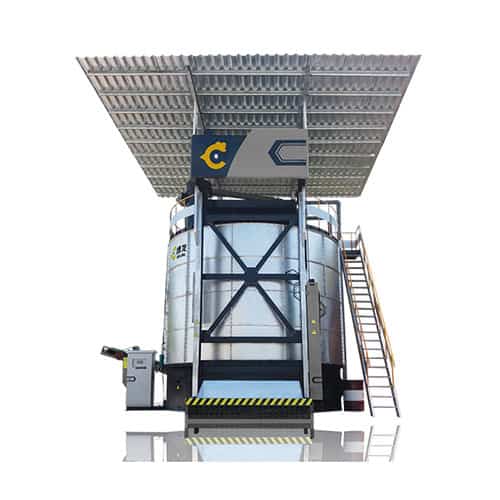
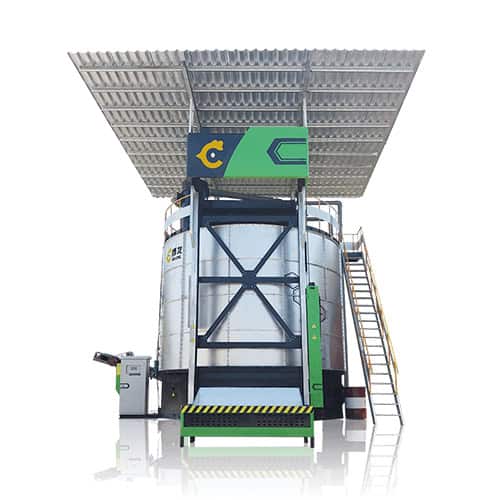
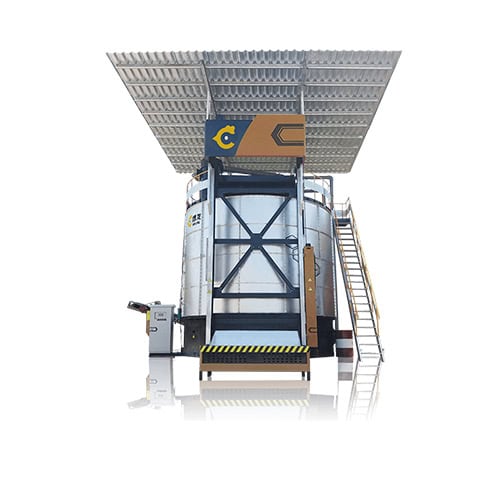
High-temperature aerobic fermentation (HTAF) tank technology answers both pressures at once. Instead of the 30–60 days a traditional open windrow composting pile needs, a sealed HTAF vessel compresses the entire cycle to 7 days — using continuous forced aeration to sustain the fermentation mass at 55°C–65°C rather than relying on manual turning and ambient weather.
Contents
The 7-day figure gets the attention, but the real engineering achievement is what happens inside that window. As the reaction mass crosses 55°C, mesophilic bacteria give way to thermophilic actinomycetes and spore-forming bacilli, which break down cellulose and hemicellulose far faster than their low-temperature counterparts. Sustaining that 55°C–65°C band for a minimum of 72 consecutive hours is what completely inactivates Salmonella spp., E. coli, and Ascaris eggs, along with weed seeds — a threshold open-air composting frequently fails to guarantee, because uneven piles develop cold spots that never reach lethal temperature. The finished output is measured against China’s NY/T 525-2021 organic fertilizer standard, requiring organic matter content of at least 45% and total NPK (nitrogen-phosphorus-potassium) of at least 5% — thresholds a properly run HTAF cycle clears routinely, because the enclosed, rapid process avoids the nitrogen volatilization losses (up to 50%) that degrade quality in slower, open systems.
Farms today typically choose among six methods: open windrow composting, anaerobic biogas digestion, HTAF tanks, mechanical turning, solid-liquid separation, and direct land application. Windrow composting is cheap to start but slow and hard to permit near residential zones; biogas digestion is capital-intensive and only pays off with an on-site energy use case; direct application is no longer compliant with tightening discharge standards such as China’s GB 18596. For a 100,000-layer commercial egg farm producing roughly 12–15 tonnes of manure daily, HTAF tanks are typically the only route that clears land, biosecurity, and revenue requirements simultaneously — which is why regulated, scaled operations are converging on it as the default choice.
Land is often the real constraint for farms near residential or waterway-sensitive zones. Because HTAF tanks are sealed and vertical, a single unit occupies only 60–120 m² — up to 70% less land than the concrete pads open windrow composting requires — while also eliminating the toxic leachate runoff that precipitation causes on exposed piles. The insulated design, built around a 304 stainless-steel liner resistant to the volatile fatty acids and ammonia in decomposing manure, sustains internal fermentation heat purely from microbial metabolism, allowing continuous operation across an extraordinary range — from -30°C in Arctic and Siberian winters to 55°C in desert and tropical equatorial climates — without energy-intensive auxiliary heating.
This is where the economics shift. China’s organic fertilizer market, valued at roughly USD 3.5 billion in 2025, is projected to reach USD 5.7 billion by 2030 (a 10.06% CAGR), with manure-derived fertilizer already accounting for about 52% of that market. A farm that installs fermentation treatment converts a cost center into a sellable asset: capital payback on an HTAF installation typically lands within 18 to 36 months, calculated simply as tons of organic fertilizer generated multiplied by market price per ton, offset against the compliance costs and lost land value that untreated manure otherwise imposes.
Henan Bolong Livestock Machinery Co., Ltd. has spent 33 years engineering this category of equipment, backed by 30+ technology patents, an annual R&D investment of USD 6 million, and ISO/CE certification. Today, more than 2,200 Bolong HTAF units operate daily across 120+ countries — including documented installations in Russia, Vietnam, Malaysia, and Spain — with a deodorization system removing 90%–98% of odor and volatile gas emissions before release, and PLC-based automation that lets a single operator run the full cycle.
Manure management is no longer a back-office environmental gesture — it is a compliance requirement with a hard deadline attached, and simultaneously one of the few remaining ways to add a genuine second revenue line to livestock operations without expanding herd size. High-temperature aerobic fermentation is currently the only widely deployed technology that resolves the land constraint, the biosecurity requirement, and the fertilizer-grade output requirement inside a single 7-day cycle.