On most poultry farms, manure management is treated as a morning chore. Scrape the droppings out of the house, move them to a pile behind the barn, and consider the job done by breakfast. But manure does not stop working when it leaves the building. A pile of scrape-out keeps releasing ammonia into the air, keeps feeding flies, keeps losing nitrogen that should have become fertilizer — and when the wind turns, it sends its gases straight back through the barn inlets. Poultry manure management that stops at the barn wall is only half a job. The other half happens after scrape-out — the choice between leaving the manure in an open pile and loading it into a manure composting tank that returns a stable, spreadable fertilizer in days.
The manure removed from the house has not been properly managed; it has simply been moved elsewhere. Inside the barn, the manure releases ammonia into the air that the birds breathe. Behind the barn, the same gas is released into the air of the farm, and a change in the wind direction can bring it back through the inlets. The pile also concentrates all the other disadvantages of manure in one place: flies breeding during the warmer months, runoff after rainfall and a mound that freezes solid in winter and becomes active again in spring.
Most farms carefully track the first part of the process — cleanout schedules, litter moisture and the time between scrapes. However, few track the second half, which includes how long the manure stays biologically active, where its gases go and how much nitrogen is lost before the pile is spread. It is this second stage that adds value, and it is this stage that poultry manure management has to address.
Ammonia does not stop being a problem at the barn wall. The gas that troubles barn air in winter is not created by the ventilation system; it is created wherever manure is left to break down in the open. Barn ammonia is a symptom of manure left to break down in the open, and the pile behind the barn keeps feeding it. Remove the pile from the equation, and the gas that came with it stops arriving at the inlets.
The second cost is in the fertilizer value itself. Poultry manure carries uric acid and undigested protein, and both are nitrogen waiting to be released. In an open pile, much of that nitrogen volatilizes as ammonia gas and drifts away before the manure is ever spread. The nutrient content you paid to feed into the birds leaks out of the pile at the same rate the smell develops. A manure pile is not storage; it is an uncontrolled digester running at the wrong speed. What should become fertilizer value becomes, instead, a reason for neighbors to call and for inspectors to pay attention.

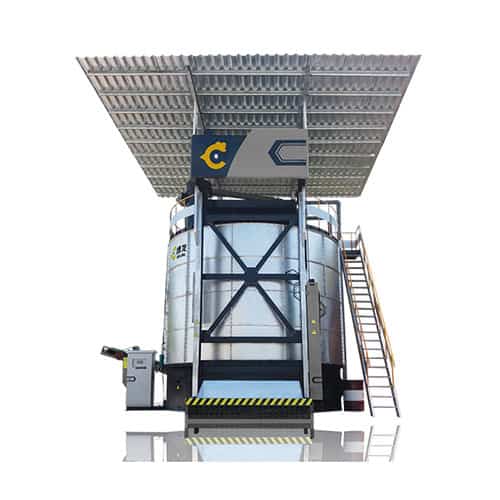
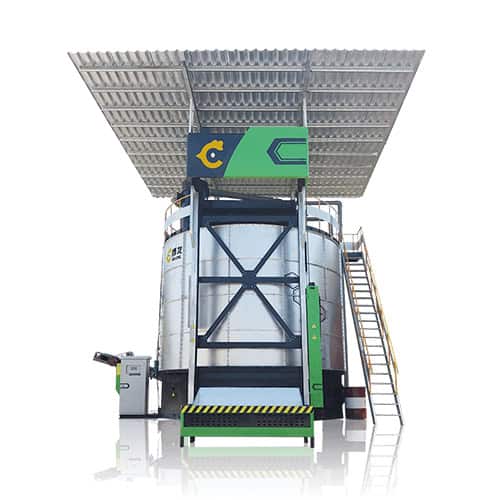
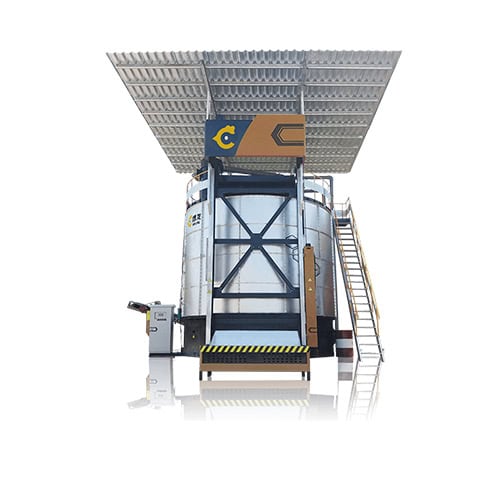
The manure composting tank is designed to complete the process started by the scrape-out. The daily cleanings are loaded into a sealed, insulated vessel where forced aeration supplies oxygen and microbes break down the manure rapidly. Core temperatures of around 55°C are sustained throughout the 7–10 day cycle. The end result is a stable, dry organic fertiliser — a finished product, not an ongoing source of gas. Farms that use this system stop measuring manure problems in weeks of open storage and start measuring them in days of controlled treatment.
It is important to be honest about the chemistry here: high-nitrogen poultry manure releases ammonia during aerobic decomposition, exactly as it does anywhere else. The difference lies in location and handling. Inside the sealed manure composting tank, the gas is generated where it can be captured — air from the vessel passes through a tail-gas treatment module that removes over 95% of ammonia and odorous compounds before discharge. Ammonia and odour control are the natural result of treating manure inside an enclosed system — they are not separate functions bolted onto a waste-handling machine. The tank manages the manure, resulting in cleaner barn air, a quieter yard and fewer conversations with neighbours.
The second advantage is time. An open pile requires months of weathering and repeated turning before it approaches stability. The enclosed manure composting tank compresses this timeline to a week and a half. It works through winter using its own biological heat, requires no turning labour and occupies a fraction of the ground. The manure’s active phase ends inside the tank, not behind the barn.
Running manure handling to the end of the line changes the operation in four visible ways. Barn air improves because fresh manure does not sit in the house long enough to build the ammonia layer that cost you feed conversion. The yard improves because there is no active pile breeding flies or broadcasting odor. The fertilizer account improves because nitrogen stays in the manure instead of leaving as gas — the compost can be spread on your own fields or sold, and it meets the organic matter and nutrient levels that make it worth more than the pile ever was. And winter stops being the season when manure management pauses: the process heats itself, so the cycle runs at the same speed in January as in July.
Seen this way, a manure composting tank is not an odor-control device with a side benefit of handling waste. It is the missing second half of poultry manure management — the step that takes what the scraper delivers each morning and turns it, in days, into something stable, dry, and valuable.
In winter, ammonia builds fastest in the barn — and eyes sting at the doorway because the pile behind it keeps releasing gas. Fans and foggers treat the air for an hour. Treating the manure removes the source. The manure composting tank does both: manure enters the sealed vessel the day it is scraped out, and the deodorizing module scrubs ammonia and odorous compounds from the air before discharge. Barn air, yard air, and neighbor relations all follow from that one choice.
That choice starts with one message. Send your house type, bird count, and where the manure goes after scrape-out — our engineers will reply with the tank model and climate-matched configuration for your farm. The second half of the job is where manure stops costing you twice and starts paying you back.
1、What is the difference between manure removal and manure management?
Removal takes the manure out of the house; management takes it to a stable endpoint. Removal is a cleanout schedule. Management is treatment — an enclosed aerobic process that stops the ammonia release, stops the fly cycle, and retains the nitrogen, so the end product is a fertilizer rather than a continuing source of gas. Most farms do the first daily; the manure composting tank is what finishes the second, turning each day’s cleanout into stable fertilizer instead of another month of pile.
2、Does the aerobic process itself release ammonia?
Yes. High-nitrogen poultry manure releases ammonia during active aerobic decomposition, just as it does in any biological breakdown. The difference is where that happens. In a manure composting tank, the gas is produced inside a sealed vessel and passed through a tail-gas deodorizing module that scrubs over 95% of ammonia and odorous compounds before anything is discharged — so the release that used to happen in the barn or behind it happens, instead, inside equipment built to handle it.
3、How do I choose the right tank size?
Sizing starts from your daily manure volume, bird count, and cleanout routine. The 11FFG series of manure composting tank models covers working volumes from 102 to 280 m³, and configuration choices — insulation, heat recovery, loading, and deodorizing modules — are matched to your climate and manure type rather than requiring custom engineering.
4、Can the system run through a cold winter?
Yes. Aerobic decomposition generates its own heat, sustaining core temperatures around 55°C without an external heat source, and insulation options support continuous operation in cold climates. Because the manure composting tank is fully enclosed, winter weather does not slow the cycle the way it slows an outdoor pile or windrow.