Livestock farming is changing how it thinks about waste. For decades, manure was something to be moved away from the barn as cheaply as possible. Today, more farms are asking a different question: what if that manure could go back to work on the farm? That shift in thinking is the heart of circular farming, and the equipment that makes it practical is a livestock waste composting machine that turns raw waste into usable organic fertilizer fast enough to keep up with daily production.
A traditional farm runs in a straight line: feed comes in, animals produce meat, milk, or eggs, and manure goes out as a cost. Every step of that last stage takes money, land, and labor, and none of it comes back as value.
A circular farm closes that line into a loop. Waste is treated on site, converted into organic fertilizer, and returned to cropland or sold to others. The idea isn’t new, but it has gained attention because farms face growing pressure from neighbors, from environmental oversight, and from the rising cost of buying inputs they could be producing themselves. The challenge has always been practical: how do you process waste quickly and reliably enough that the loop actually works?
Most farms don’t lack the intention to recycle manure. They lack a process fast and consistent enough to do it at scale. Open piles and windrow composting take weeks or months, depend on the weather, and need large areas of land. By the time one batch is finished, several more have piled up behind it.
This is where a livestock waste composting machine changes the picture. Instead of a slow, outdoor process that varies with the seasons, it gives the farm a controlled, enclosed process with a predictable daily output. That predictability is what turns “we compost when we can” into a real part of how the farm operates.

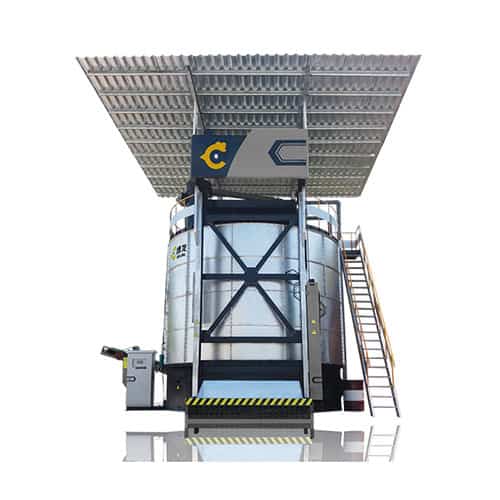
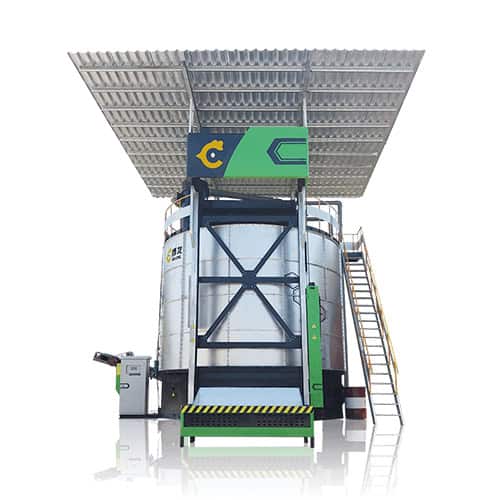
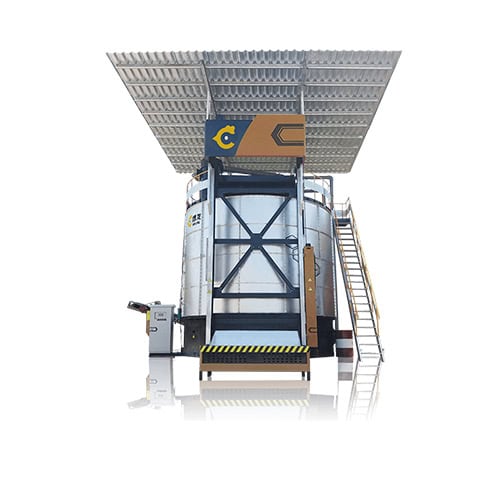
Bolong’s High Temperature Aerobic Compost Tank is built around continuous operation, which is what a circular system needs:
Daily in, daily out — organic waste is loaded into a hopper, lifted hydraulically to the top of the tank, and dumped in. Finished organic fertilizer is recovered at the bottom of the tank every day.
Five mixing blades — they slowly stir the material inside the tank, and warm air is delivered through holes in the blades to keep fermentation moving.
Heat recovery — a heat exchanger uses the warm exhaust air to heat the fresh air going back into the tank, which speeds up fermentation and helps evaporate excess moisture while saving energy.
About 7 days from waste to fertilizer — on average, organic waste becomes high-quality compost fertilizer in a week.
Integrated odor control — a deodorizing system uses ammonia water absorption, an activated carbon filter, and odor-removing microorganisms to break down gases such as ammonia, hydrogen sulfide, and methanethiol.
Together, these features make the tank a working part of the farm’s daily routine, not a project that needs constant attention.
A circular farm rarely produces just one kind of waste, but not every stream carries the same weight in the tank. Animal manure is the feedstock the tank is built around — it supplies the nitrogen the process runs on, and it is what the livestock waste composting machine is sized against. Dry agricultural materials such as straw, soybean meal and cottonseed meal go in as conditioners, correcting moisture and the carbon-to-nitrogen ratio so the manure ferments properly.
The main requirement is moisture. Material below 65% moisture goes straight in; a wetter load is blended with a dry conditioner until it holds together. That is the extent of the adjustment, and most farms never have to buy anything to make the process run. Solid can be mixed with solid and solid with slurry, and viscous material that would clog other equipment moves through this tank without trouble.
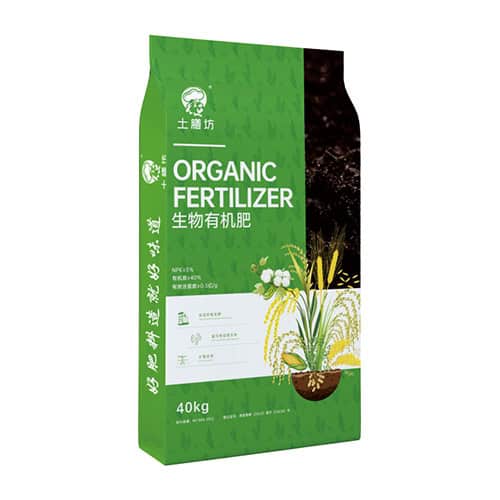
The output is the part that makes the loop worth closing. The final product is biosecure, high-quality organic fertilizer, and with a livestock waste composting machine it arrives every day rather than in occasional large batches.
For a farm, that organic fertilizer can go back onto its own fields, reducing the need to buy outside inputs. It can also be offered to nearby growers who want organic soil amendments. Either way, waste that used to be a cost center becomes something with a use, and often a value. The farm is no longer paying to get rid of something; it is producing something.
Many farms assume that recycling waste on site means more land, more labor, and more complications. The compost tank is designed to avoid that. It uses a vertical, enclosed structure that needs only a small footprint, so it doesn’t compete with barns, storage, or cropland for space. An automatic control system supports daily operation, and the tank can run effectively across a wide range of climates, including regions with high humidity and regions with very low temperatures.
That combination matters for circular farming in practice. A loop that only works in good weather, or only when someone has time to turn a pile, isn’t really a loop. A system that runs the same way every day is.
Bolong Group was founded in 1993 and has spent more than 30 years working on the modernization of livestock and poultry farming. In 2015, the company launched China’s first livestock waste biosecure treatment equipment, and today it operates a 40,000-square-meter intelligent manufacturing base with a fully automated compost tank production line built around Trumpf equipment and an annual capacity of 1,000 units.
Bolong’s compost tanks are running in projects in Vietnam, Russia, Spain, Malaysia, and the USA, as well as on livestock and sewage treatment projects across China. Each customer receives operation and maintenance training, a one-year warranty from delivery, and ongoing technical support, including remote diagnostics.
1、What is a livestock waste composting machine, and how is it different from regular composting?
It is an enclosed system that composts organic waste under controlled conditions instead of in open piles. The Bolong compost tank turns waste into organic fertilizer in about 7 days, with daily loading and daily discharge, while open composting is slower and depends more on the weather.
2、Can a livestock waste composting machine handle manure from different animals?
Yes. Poultry litter, pig, cattle and sheep manure all run through the same tank–what changes is moisture and texture, not the machine. A wet load is blended with a dry conditioner, and manure collected with bedding goes in as long as the manure stays the bulk of it.
3、Does circular farming mean more work for my team?
Not with an automated system. The process is continuous, controlled by an automatic control system, and supported by training, so daily work is mainly loading material and recovering finished fertilizer.
Every circular farm begins with one decision: to stop treating waste as the end of the line. Tell the Bolong team what your farm produces each day, and we’ll show you how a livestock waste composting machine can turn it into your next input.