As we enter 2026 and livestock farming continues to grow, the demand for manure treatment during the production of organic fertiliser keeps rising.
In regions where land is relatively scarce, it is often necessary to arrange fermentation zones, raw material storage areas and finished product storage zones within the same facility. Traditional composting methods and flat-bed fermentation equipment require large areas and have a scattered layout, which impacts production efficiency and limits future capacity expansion.
Against this backdrop, achieving efficient fermentation within limited space using new equipment such as vertical manure to fertilizer fermentation tanks has become a critical issue that organic fertiliser enterprises must address.
When planning organic fertiliser projects, many companies tend to focus on the processing capacity of individual units. However, in practice, it is often the utilisation of space that truly constrains production efficiency.
The excessive horizontal footprint of equipment can lead to a series of chain reactions.
Low site utilisation, hindering expansion
Long material transfer distances complicate management.
Dispersed fermentation zones, which compromise operational stability
Consequently, an increasing number of organic fertiliser producers are re-evaluating the design of their fermentation equipment, shifting from ‘horizontal expansion’ to ‘vertical integration’. Vertical manure to fertilizer fermentation tanks are gaining market attention precisely within this trend.

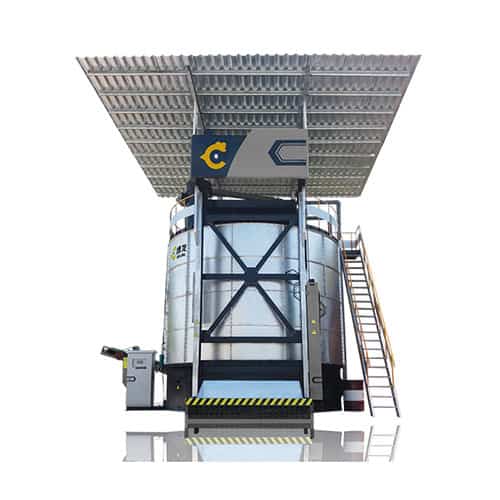
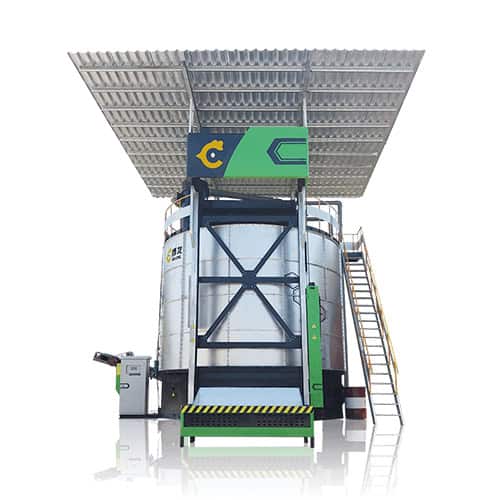
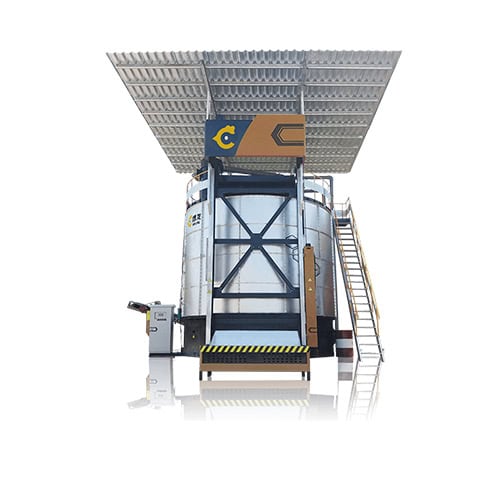
By completing the fermentation process in a vertical space, vertical manure to fertilizer fermentation tanks significantly reduce the need for horizontal land. Under identical land area conditions, they achieve a higher processing capacity while maintaining an excellent stable fermentation environment.
Compared to traditional fermentation methods, vertical manure to fertilizer fermentation tanks offer distinct structural advantages.
For organic fertiliser producers seeking to increase output within the constraints of an existing site, vertical manure to fertilizer fermentation tanks offer a more practical and sustainable solution.

At the recently concluded AHCAB exhibition in Bangladesh, the vertical manure to fertilizer fermentation tank structure displayed at our Bolong stand attracted many local industry professionals who wanted to discuss the product in more detail.
After learning about the design of the equipment, many visitors focused on the footprint of the vertical manure to fertilizer fermentation tank, factory layout options and actual production capacity within limited space. During the exhibition, ‘How to enhance space utilisation with vertical manure to fertilizer fermentation tanks’ became a central discussion topic.
By 2026, the focus of organic fertiliser production will shift from simply establishing whether fermentation is possible to achieving higher efficiency and lower operational costs within constrained spaces.
If you are looking to increase fermentation efficiency without expanding your facility or want to find out if vertical manure to fertilizer fermentation tanks are suitable for your production scale and site conditions, we would like to invite you to discuss this further.