As environmental regulations continue to tighten, the livestock industry is entering a phase of more refined management. The official implementation of the Technical Guidelines for Ammonia Emission Accounting in Large-Scale Livestock Farms signals the start of a new era of standardised accounting and comprehensive oversight of ammonia emissions from livestock farms.
Against this backdrop, traditional methods that rely on open-air storage or basic treatment are increasingly failing to meet new environmental requirements. A growing number of livestock enterprises are adopting more controllable treatment methods, such as the standardised processing of manure and wastewater using animal manure composting machines, to minimise ammonia emissions at source and improve management control.
For these enterprises, this is not just a policy change, but a move towards more standardised and mechanised approaches to manure and wastewater treatment.

“Accounting” is at the center of these new rules. It will no longer be possible to determine ammonia emissions based only on empirical judgment. Instead, technical methods will be used to do so throughout the entire livestock production process.
There will be one set of rules for all parts of the process, from housing animals to storing and treating manure. There will also be direct links between this data and pollution discharge permits, taxes for protecting the environment, subsidy policies, and green certification.
It is easier to keep track of data and processes with mechanized treatment methods like animal manure composting machines. This makes it easier to meet emission accounting requirements.
The following types of farms will be given priority for regulation based on the rules:
Pig farms that raise 500 or more pigs a year; big farms that raise cows and chickens.
If these businesses don’t follow the rules for calculating ammonia emissions, they may have to take corrective action, limit production, or even face stricter environmental rules.
As a result, using only traditional treatment methods is no longer enough to meet the new rules. More and more large-scale livestock farms are choosing to use more stable treatment solutions, like large-scale animal manure composting machines.
In real life, ammonia emissions come from more than just the stage of raising animals; they also come from the whole process of treating manure.
These are:
Breaking down of manure and urine in places where animals live
How to store manure
Composting and fermenting outside
Because it doesn’t control the temperature and oxygen levels well, traditional composting is especially likely to have problems like incomplete fermentation or concentrated ammonia releases. This has an effect on the environment around it and makes it harder to figure out how much pollution is being released.
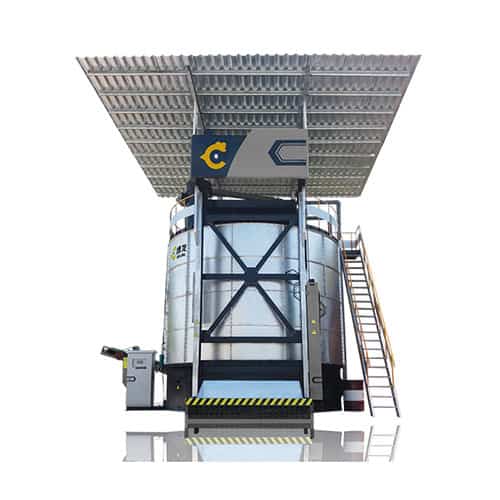
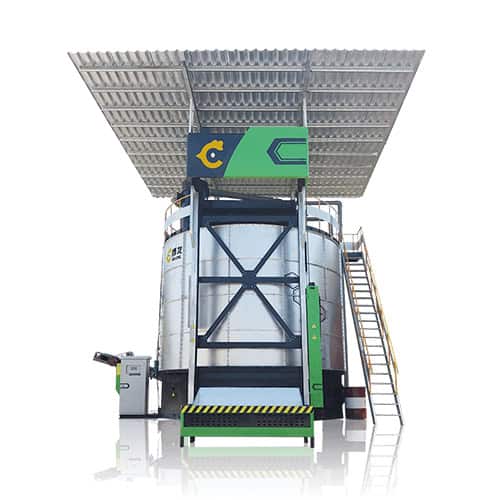
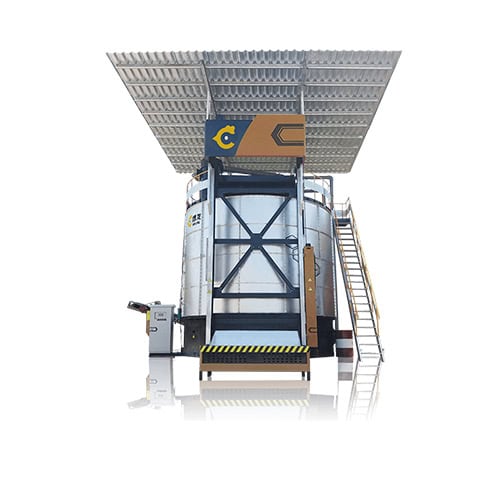
Of the various technologies for treating manure, animal manure composting machines are gradually gaining the attention of more and more livestock enterprises thanks to their stability and controllability.
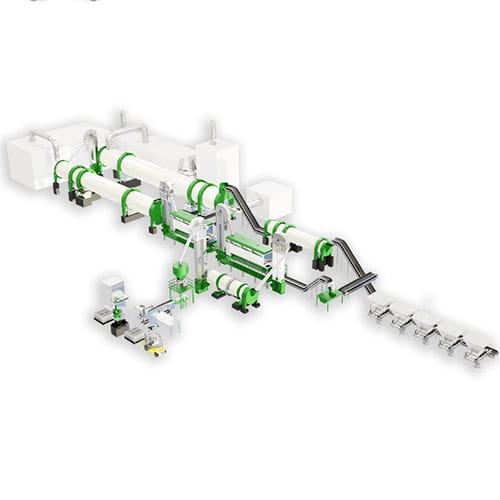
Addressing the issues of unstable temperature, uneven ventilation and concentrated ammonia release associated with traditional composting methods, these machines utilise a relatively enclosed environment to continuously regulate temperature, oxygen and moisture levels. This stabilises the fermentation process and reduces uncontrolled ammonia volatilisation.
During operation, the equipment maintains a stable, high-temperature fermentation state, accelerating the decomposition of organic matter and improving uniformity of fermentation. Compared to traditional methods, automated animal manure composting machines reduce the need for manual turning, making the entire treatment process more standardised and controllable.
Additionally, integrated ventilation and deodorisation systems enable centralised treatment of generated gases, thereby improving the farm environment and facilitating subsequent emission management.
Overall, high-temperature aerobic fermentation technology improves treatment efficiency and provides a viable pathway for livestock farms to achieve stable emission reductions.
As regulations continue to tighten, the treatment of manure is shifting from being just an environmental requirement to becoming a critical component of resource utilisation.
Using high-temperature aerobic fermentation technology, livestock manure can be converted into stable organic fertiliser products. This helps to reduce emission pressures and enhance the value of resources.

For large-scale livestock enterprises, this approach helps strike a balance between ’emission reduction’ and ‘efficiency improvement’.
The introduction of ammonia emission accounting policies indicates that industry standards are gradually increasing. To ensure stable future development, livestock enterprises need to optimise their manure treatment models in advance.
Compared to traditional methods, equipment-based solutions such as animal manure composting machines are becoming a key way of meeting environmental requirements.
If you are looking for more compliant manure treatment solutions or would like to find out how animal manure composting machines can help reduce emissions, please contact us to discuss customised solutions for your business.