

Key Takeaways at a Glance
Table of Contents
- Why Livestock Farmers Must Prioritize Manure Management
- Livestock Manure Treatment — Technology Comparison
- How Fermentation Tanks Work — Core Technology Explained
- Fermentation Tank Buyer’s Guide for Livestock Farmers
- Bolong Fermentation Tank — Products & Real-World Applications
- 20 Questions Every Livestock Farmer Asks About Fermentation Tanks
- International Outlook — Manure Management Opportunities in Southeast Asia
- About Henan Bolong Livestock Machinery Co., Ltd.
Chapter 1: Why Livestock Farmers Must Prioritize Manure Management
1.1 What happens if a livestock farm ignores manure management today?
A farm that continues to stockpile or spread raw manure without treatment now faces three compounding risks: regulatory penalties, rising input costs, and a forfeited revenue stream. China’s Ministry of Agriculture and Rural Affairs reports that the country’s livestock sector generates approximately 3.8 billion tonnes of manure annually, with a comprehensive resource-utilization rate of 79.4% in 2023 — leaving over 20% of national output still non-compliant with treatment targets. The national policy roadmap calls for 80% utilization by 2025 and 90% by 2035, meaning enforcement pressure on the remaining untreated volume will only intensify.
Farms that delay manure treatment infrastructure are not avoiding a cost — they are deferring a larger one, plus the compliance risk and lost fertilizer revenue that come with it.
1.2 Regulatory pressure: which policies actually apply to my farm?
Three documents form the compliance backbone for livestock manure management in China, and international equivalents are tightening on the same timeline:
- GB 18596-2001 — Discharge Standard of Pollutants for Livestock and Poultry Breeding: sets enforceable limits on COD, ammonia nitrogen, and heavy metals (e.g., Cu ≤1 mg/L, Zn ≤2 mg/L) in any wastewater or runoff leaving a farm site.
- State Council Document Guo Ban Fa [2017] No. 48 — Opinion on Accelerating the Resource Utilization of Livestock and Poultry Farming Waste: the national policy mandate requiring large-scale farms to install manure treatment facilities as a precondition for operating permits.
- NY/T 525-2021 — Organic Fertilizer (national industry standard): defines the quality bar a farm’s processed manure output must clear (organic matter ≥45%, total NPK ≥5%, moisture ≤30%) to be legally sold as commercial fertilizer.
- EU Green Deal Farm-to-Fork Strategy: targets a 50% reduction in nutrient losses by 2030, effectively restricting raw manure spreading in nutrient-sensitive catchments across the European market.
For export-oriented producers and international buyers, the direction of travel is the same everywhere: raw, untreated manure is moving from a tolerated byproduct to a regulated liability.
1.3 Economic pressure: how much does poor manure management actually cost?
Manure handling is not a marginal line item. Industry cost analyses of large-scale pig farms put manure and waste management at 8%–15% of total operating costs, with collection and storage alone accounting for 3%–5%. Left untreated, that cost is pure overhead. Processed through fermentation, the same material becomes a sellable asset — China’s organic fertilizer market was valued at approximately USD 3.5 billion in 2025 and is projected to reach USD 5.7 billion by 2030 (10.06% CAGR), with manure-derived fertilizer already commanding roughly 52% of that market.
1.4 The opportunity: turning a compliance cost into a revenue line
A farm that installs fermentation treatment is not just avoiding fines — it is entering the organic fertilizer supply chain. Nitrogen retained through a fast, enclosed thermophilic cycle (rather than lost to volatilization in open windrows, which can shed up to 50% of nitrogen content) becomes marketable NPK value. For a mid-sized operation, this typically converts a cost center into a secondary revenue stream sold to local cooperatives, crop farms, or commercial fertilizer blenders.
Core conclusion: For any farm above smallholder scale, manure management has shifted from an optional environmental gesture to a mandatory compliance requirement and a measurable profit-and-loss line — and fermentation tank technology is currently the fastest route to satisfying both at once.
Chapter 2: Livestock Manure Treatment — Technology Comparison
2.1 What are the six main ways to treat livestock manure?
Livestock farms today choose among six established treatment routes: traditional windrow composting, anaerobic (biogas) digestion, high-temperature aerobic fermentation (HTAF) tanks, mechanical turning composting, solid-liquid separation, and direct land application of raw manure. Each occupies a different point on the cost, speed, and compliance spectrum, and the right choice depends primarily on farm scale, available land, and whether the farm wants a marketable fertilizer output or simply a discharge-compliant byproduct.
| Dimension | Windrow Composting | Biogas Digestion | HTAF Tank | Mechanical Turning | Solid-Liquid Separation | Direct Land Application |
|---|---|---|---|---|---|---|
| Processing cycle | 30–60 days | 20–40 days | 7 days | 15–25 days | 1–2 days (separation only) | None (untreated) |
| Land footprint | Large (open pads) | Large (digester + storage) | Minimal (60–120 m²) | Large (open pads) | Small | None, but pollutes soil |
| Capital investment | Low | High | Medium | Medium | Low–Medium | None |
| Output product | Low-grade compost | Biogas + digestate | NY/T 525-compliant organic fertilizer | Compost, variable quality | Separated solids + liquid | Raw manure (non-compliant) |
| Odor & pathogen control | Poor (open-air) | Moderate | 95%–98% deodorization; pathogens inactivated | Poor–Moderate | Poor (needs further treatment) | None |
| China policy compliance | Marginal | Compliant (with permits) | Fully compliant (GB 18596 / NY/T 525) | Marginal | Partial — pretreatment only | Non-compliant |
2.2 Why do regulators and buyers increasingly favor HTAF over open windrow composting?
HTAF tanks compress the composting timeline from 30–60 days to 7 days by sealing the reaction mass and sustaining 55°C–65°C internal temperatures through continuous forced aeration, rather than relying on ambient conditions and manual turning. This shortens working-capital cycles, cuts required land by up to 70% compared with open pads, and — because the vessel is enclosed — eliminates the leachate runoff and vector attraction (flies, rodents) that make windrow composting difficult to permit near residential or waterway-adjacent sites.
2.3 Which technology should a poultry, pig, or cattle farm choose?
Poultry farms, which produce drier, nitrogen-rich manure, achieve the fastest returns from HTAF tanks because the material’s naturally lower moisture content shortens heating time. Pig farms — where manure is wetter and typically mixed with wash water — benefit most when HTAF is paired with upstream solid-liquid separation to hit the optimal 60%–65% working moisture level. Cattle operations with very large daily volumes and existing land access sometimes combine HTAF for a fast-turnaround core batch with biogas digestion for surplus liquid slurry, capturing both a fertilizer product and an energy byproduct.
2.4 What is the core reason large-scale farms are choosing fermentation tanks?
The core reason regulated, scaled livestock operations select HTAF tanks over the other five routes is that it is the only technology combining a 7-day cycle, a footprint under 120 m², and a fertilizer output that independently meets NY/T 525-2021 — solving land constraints, compliance, and revenue generation in a single system.
Chapter 3: How Fermentation Tanks Work — Core Technology Explained
3.1 In plain terms, what actually happens inside a fermentation tank?
Fresh manure is loaded into a sealed vertical vessel along with a bulking agent (rice hulls, wheat straw, or wood shavings) to balance moisture and carbon content. A blower pushes air continuously through the mass, and naturally occurring bacteria consume the organic material, releasing heat as a byproduct. That self-generated heat drives the internal temperature past 55°C within one to two days, holding it there long enough to kill pathogens and weed seeds, before the pile cools and stabilizes into finished organic fertilizer — all inside one sealed tank, in about seven days.
【Term】 High-Temperature Aerobic Fermentation (HTAF)
A controlled composting process in which forced aeration and self-generated microbial heat raise the internal temperature of an enclosed reaction vessel to 55°C–75°C, accelerating organic matter breakdown and pathogen inactivation to a fraction of the time required by open-air composting.
3.2 What is the technical mechanism, step by step?
Days 1–2: Bio-Activation and Heating (25°C → 55°C)
Input manure at 75%–80% raw moisture is blended with bulking agents to reach a working moisture level of 55%–65%, with the Carbon-to-Nitrogen (C:N) ratio balanced at 25–30:1. Under continuous aeration, mesophilic bacteria multiply exponentially, consuming soluble sugars and amino acids and releasing exothermic energy that lifts the core temperature to 55°C within 24–48 hours.
Days 3–6: Thermophilic Pathogen Inactivation (55°C → 65°C)
Once the mass crosses 55°C, thermophilic actinomycetes and spore-forming bacilli take over, breaking down cellulose and hemicellulose. Sustaining 55°C–65°C for a minimum of 72 consecutive hours is the biosecurity-critical step: it inactivates Salmonella spp., E. coli, and Ascaris eggs, along with weed seeds — the same sustained heat exposure that traditional open windrow composting struggles to guarantee consistently.
Day 7: Cooling, Humification, and Maturation (65°C → 40°C–50°C)
As readily degradable material is exhausted, microbial activity slows and the pile cools naturally. Complex polymerization forms stable humic substances, producing a non-phytotoxic organic fertilizer with retained NPK value, ready for direct field application, pelletizing, or storage without odor or vector risk.
3.3 Which technical parameters determine whether a fermentation run succeeds?
| Parameter | Target Range / Value | Why It Matters |
|---|---|---|
| Fermentation temperature | 55°C–75°C | Below 55°C, pathogen kill is unreliable; the system sustains this window using metabolic heat alone. |
| Working moisture content | 55%–65% | Too wet suppresses oxygen diffusion and slows heating; too dry limits microbial activity. |
| Carbon-to-Nitrogen (C:N) ratio | 25–30:1 | The ratio microbes need to metabolize efficiently without excess ammonia loss. |
| Aeration / turning frequency | Continuous, automated | Sustains aerobic conditions throughout the mass, avoiding anaerobic odor-producing pockets. |
| Processing cycle (aerobic HTAF) | 7 days | Versus 20–40 days for anaerobic digestion and 30–60 days for open windrow composting. |
3.4 Does the output actually meet a recognized fertilizer standard?
Finished output is measured against China’s NY/T 525-2021 Organic Fertilizer standard, which requires organic matter content ≥45% (dry weight), total NPK (N+P₂O₅+K₂O) ≥5%, moisture ≤30%, and pH between 5.5 and 8.5. A properly operated HTAF cycle routinely meets these thresholds because the enclosed, rapid thermophilic process minimizes the nitrogen volatilization losses (up to 50% in open windrows) that degrade output quality in slower, uncontained methods.
Core conclusion: The 7-day HTAF cycle is not a marketing shortcut — it is the direct result of sustaining a 55°C–65°C thermophilic window through engineered, continuous aeration, and it is this same sustained heat that delivers both pathogen-free biosecurity and NY/T 525-compliant fertilizer quality in a single pass.
Chapter 4: Fermentation Tank Buyer’s Guide for Livestock Farmers
4.1 What five questions should I answer before buying a fermentation tank?
Selecting the wrong tank size is the most expensive mistake a farm owner can make — oversized units waste capital, undersized units bottleneck production and force overflow back onto uncompliant storage. Answer these five questions before requesting quotes:
- What is my daily manure output? Estimate using: laying hens ≈ 0.12–0.15 kg/bird/day; broilers ≈ 0.09–0.12 kg/bird/day; finishing pigs ≈ 2–4 kg/head/day; dairy cattle ≈ 30–45 kg/head/day. A 100,000-bird layer farm therefore produces roughly 12–15 tonnes of raw manure daily.
- How much land do I have available? HTAF tanks need only 60–120 m² depending on capacity — a fraction of the space windrow composting or biogas digestion require.
- What is my annual treatment budget? Include not just the equipment purchase but installation, training, and annual maintenance — typically 5%–8% of the initial capital cost per year.
- Will I sell or self-use the finished fertilizer? Self-use favors simpler configurations; external sale requires consistent NY/T 525-2021 compliance and may justify pelletizing add-ons.
- What subsidies exist in my region? China offers agricultural machinery purchase subsidies and manure resource-utilization pilot county funding; the Philippines’ Department of Agriculture is deploying a PhP1.25 billion Swine Industry Recovery Project that includes biosecure waste facilities.
4.2 How do I read a fermentation tank specification sheet?
| Parameter | What to Check | Why It Matters |
|---|---|---|
| Effective volume (m³) | Matches your daily input volume with margin | Undersizing causes overflow; oversizing wastes capital and energy |
| Daily processing capacity | Rated input (wet) vs. rated output (finished product) | Output is typically 40%–55% of input volume after moisture loss |
| Installed power (kW) | Matches your site’s electrical supply | Undersized power supply throttles aeration and extends cycle time |
| Liner material | 304 stainless steel (minimum) | Manure is corrosive; mild steel liners pit and fail within 2–3 years |
| Insulation | High-density polyurethane foam | Determines whether the tank can self-sustain heat in cold climates without auxiliary heating |
| Automation level | PLC control, one-person operation | Directly affects labor cost and consistency of the fermentation cycle |
| Noise / emissions compliance | Deodorization efficiency rating (%) | Determines whether the site can operate near residential areas under local rules |
4.3 Which tank configuration fits my farm size?
| Farm Scale | Typical Daily Manure Output | Recommended Configuration |
|---|---|---|
| Small (<50,000 layers / <500 pigs) | ≈6–8 tonnes/day | Single 86 m³ tank, 40.9 kW, ~55 m² footprint |
| Medium (50,000–200,000 layers / 500–2,000 pigs) | ≈8–14 tonnes/day | Single 102–120 m³ tank or dual small units for redundancy |
| Large (>200,000 layers / >2,000 pigs) | 14+ tonnes/day | Multiple 120 m³ tanks operated in parallel, staggered loading |
| Farming groups / agricultural complexes | Multi-site, variable | Customized turnkey line: intake → HTAF fermentation → drying → pelletizing → packaging |
4.4 What must I verify before signing a purchase contract?
- Production license and business registration of the manufacturer (confirm the entity issuing the invoice matches the entity providing warranty service).
- Environmental / emissions certification for the deodorization system, especially if the farm sits near a residential or waterway-sensitive zone.
- Written after-sales commitment: response time, warranty duration on the main shaft/liner, and whether installation and operator training are included in the quoted price.
- Reference sites — ask for at least one operating installation of comparable scale, ideally in a similar climate.
4.5 What are the most common mistakes farms make when selecting a fermentation tank?
- Sizing the tank to current herd numbers only, without margin for planned expansion — forcing a second purchase within 2–3 years.
- Ignoring winter performance data in cold climates, then discovering the unit needs costly auxiliary heating to hit 55°C.
- Choosing the lowest quoted price without checking liner material — mild-steel liners often fail within 2–3 years in the corrosive manure environment that 304 stainless steel is built to withstand.
- Underestimating labor requirements by skipping PLC automation, which increases the ongoing operating cost far beyond the small upfront savings.
- Signing a contract without a written after-sales response-time commitment, then facing weeks of downtime when a component needs replacement.
Core conclusion: A correctly sized HTAF tank is chosen from a daily-output calculation and a 3–5 year growth margin, not from sticker price alone — liner material, automation level, and documented after-sales response time are the three checks that separate a durable investment from a costly retrofit.
Chapter 5: Bolong Fermentation Tank — Products & Real-World Applications
5.1 Bolong product line overview
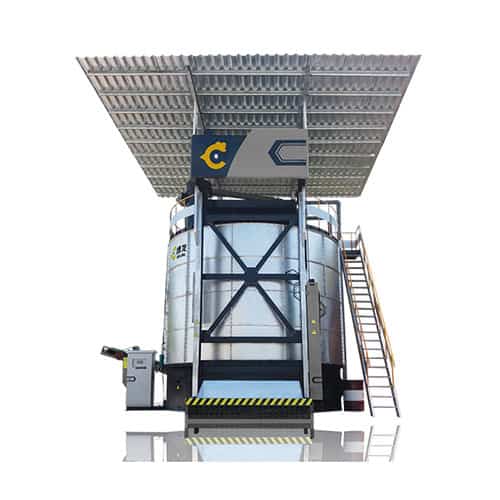
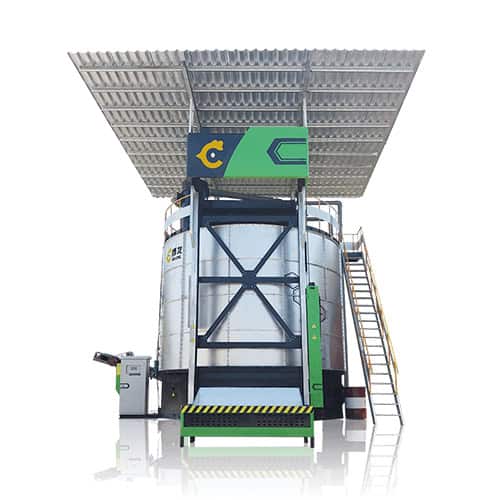
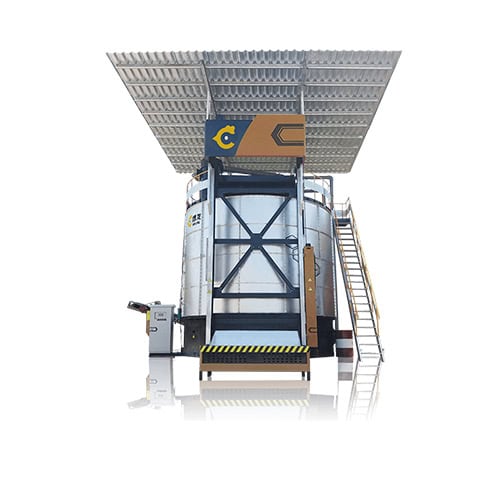
Henan Bolong Livestock Machinery Co., Ltd. has manufactured livestock waste processing equipment since 1993. Its Farm Waste Management fermentation tank series is built as a closed vertical vessel with a 304 stainless-steel inner liner and a high-density polyurethane foam insulation layer, running on standard 380V/50Hz power. As of this publication, 2,200+ Bolong units are in daily operation across more than 120 countries, backed by an annual production capacity of 1,000 units from a 160,000 m² manufacturing base.
| Model Class | Effective Volume | Daily Input Capacity | Rated Output | Installed Power | Footprint |
|---|---|---|---|---|---|
| Compact (5500mm diameter) | 86 m³ | 7–10 m³/day | 3–4.5 m³/day | 40.9 kW | ≈55 m² |
| Standard (6000mm diameter) | 102 m³ | 8–12 m³/day | 4–5 m³/day | 40.9 kW | ≈60 m² |
| High-capacity (6000mm, 9000mm height) | 120 m³ | 8–14 m³/day | 4–5.5 m³/day | 40.9+ kW | ≈60–80 m² |
5.2 Core technical advantages
- Footprint efficiency: Vertical sealed design cuts required land by up to 70% versus open windrow composting, fitting comfortably within a 60–80 m² pad.
- Corrosion-resistant construction: Heavy-gauge 304 stainless steel liner resists the volatile fatty acids and high ammonia concentrations that pit standard steel liners within a few years.
- Climate independence: Polyurethane thermal insulation sustains internal fermentation temperature across an operating range of -30°C to 55°C ambient, relying on self-generated microbial heat rather than energy-intensive auxiliary heating.
- One-person operation: PLC-based automated aeration and control systems allow a single operator to run the full fermentation cycle.
- Deodorization performance: The integrated purification system removes 90%–98% of odor and volatile gas emissions before atmospheric release.
- Engineering pedigree: 33 years of manufacturing history, 30+ technology patents, an annual R&D investment of USD 6 million, and ISO/CE certification.
5.3 Application scenarios by farm type
Scenario A — Commercial layer (egg) farm
A farm running approximately 100,000 laying hens generates an estimated 12–15 tonnes of raw manure daily (at 0.12–0.15 kg/bird/day). Sized against Bolong’s 120 m³ configuration (8–14 m³/day input capacity), this scale typically requires two parallel tanks operated on a staggered loading schedule to maintain continuous 7-day-cycle throughput without a backlog.
Scenario B — Broiler farm with seasonal peak production
Broiler operations produce drier manure with a shorter grow-out cycle, making moisture control the primary sizing variable rather than raw volume. A single 102 m³ tank comfortably matches the daily output of a 150,000–200,000-bird broiler operation.
Scenario C — Farrow-to-finish pig farm
A 2,000-head finishing operation generates roughly 4–8 tonnes of manure daily, typically at higher moisture content requiring upstream solid-liquid separation. Paired with an 86–102 m³ tank, this configuration is consistent with the 18–36 month capital payback range typical of mid-sized manure valorization projects.
These three scenarios are illustrative sizing examples calculated directly from Bolong’s published equipment specifications and industry-standard manure production rates; actual throughput and payback vary by feed composition, local fertilizer pricing, and site conditions.
5.4 Documented international deployments
Bolong equipment is in service across a range of climates and regulatory environments, including a poultry manure treatment project in Spain, a large-scale poultry farm installation in Vietnam, a tropical-climate customized composting solution in Malaysia, and an aerobic compost tank project in Russia — spanning the -30°C to 55°C operating range the HTAF system is engineered to handle.
5.5 Service system: installation through after-sales support
- Installation & commissioning: One-on-one engineer guidance provided at first purchase.
- Operator training: Delivered through a dedicated training facility, backed by a USD 50 million company investment in training infrastructure.
- Response time: 24/7 customer service hotline with first-response commitment on reported issues.
- Warranty: 10-year warranty on the main shaft; free replacement parts for quality-related defects.
- Ongoing maintenance: Annual technician overhaul visits plus proactive system upgrades.
Core conclusion: Bolong’s HTAF tanks are engineered around three constraints that matter most to farm owners — minimal land footprint, corrosion life in a hostile manure environment, and unattended climate independence from -30°C to 55°C — validated across 2,200+ installations in 120+ countries.
Chapter 6: 20 Questions Every Livestock Farmer Asks About Fermentation Tanks
This chapter answers the questions farm owners most frequently ask before purchasing manure treatment equipment, grouped into five practical categories.
A. Technical Understanding
What is the real difference between a fermentation tank and traditional composting?
A fermentation tank compresses a 30–60 day open windrow composting cycle into 7 days by sealing the reaction mass and sustaining 55°C–65°C through continuous forced aeration rather than relying on manual turning and ambient weather. The sealed design also prevents leachate runoff and vector attraction, and requires up to 70% less land.
Does high-temperature aerobic fermentation actually kill pathogens? What is the kill rate?
Yes — maintaining 55°C–65°C for a minimum of 72 consecutive hours completely inactivates Salmonella spp., E. coli, and Ascaris eggs, along with weed seeds. This is also why biosecurity-sensitive operations managing African Swine Fever or Avian Influenza risk increasingly specify enclosed HTAF systems.
Can the organic fertilizer from a fermentation tank actually be sold? What is it worth?
Yes, provided it meets China’s NY/T 525-2021 standard. China’s organic fertilizer market was valued at roughly USD 3.5 billion in 2025 and is projected to reach USD 5.7 billion by 2030, with manure-derived product already accounting for about 52% of that market.
Does processing chicken manure differ from processing pig manure?
Yes, primarily in starting moisture content. Poultry manure is typically drier and higher in nitrogen, shortening the heating phase. Pig manure is wetter and usually needs upstream solid-liquid separation before fermentation.
B. Selection & Decision-Making
I have 100,000 laying hens — how much manure do I produce and what size tank do I need?
At 0.12–0.15 kg of manure per bird per day, 100,000 layers produce approximately 12–15 tonnes of raw manure daily, typically requiring two parallel 120 m³ tanks on a staggered loading schedule.
Fermentation tank vs biogas digester — which is better for a poultry farm?
For most poultry operations, a fermentation tank is faster and lower-maintenance: a 7-day cycle versus 20–40 days for anaerobic digestion, with no requirement to manage or monetize biogas output.
My land is limited — how much space does a fermentation tank actually need?
A single Bolong HTAF unit occupies only 55–80 m², a footprint reduction of up to 70% versus open windrow composting or biogas systems.
Northern winters are cold — will a fermentation tank still work?
Yes. Bolong’s HTAF tanks operate continuously from -30°C to 55°C ambient temperature, relying on high-density polyurethane insulation that retains internally generated metabolic heat.
C. Investment & ROI
How much does a fermentation tank cost, and how much does price vary by scale?
Pricing scales primarily with tank volume and configuration complexity. Because published list pricing varies by region and configuration, request a tailored quote referencing your calculated daily manure output through www.bolongeco.com.
Are there government subsidies for fermentation tanks? How do I apply?
In China, agricultural machinery purchase subsidies and manure resource-utilization pilot county funding are available in many provinces. In the Philippines, the Department of Agriculture’s PhP1.25 billion Swine Industry Recovery Project (announced January 2025) is funding biosecure waste facilities.
How many years does it take to pay back the investment?
Farms typically achieve capital payback within 18 to 36 months, depending on manure volume processed and local fertilizer or energy pricing.
What are the main annual operating costs?
Ongoing costs center on electricity for aeration blowers and PLC control, bulking agent material, and routine maintenance — typically 5%–8% of the initial capital cost per year.
D. Operation & Maintenance
Is daily operation complicated? Do I need dedicated staff?
No — Bolong’s HTAF tanks use PLC-based automation designed to be run by one person. Daily tasks are limited to loading manure and bulking agent, monitoring temperature, and unloading finished product.
Temperature will not rise / there is odor — how do I troubleshoot?
The two most common causes are moisture imbalance and insufficient aeration. Check that working moisture is within 55%–65% and the C:N ratio is near 25–30:1. Bolong’s 24/7 support line provides remote diagnostic guidance.
What is the typical service life of a fermentation tank?
A properly maintained 304 stainless steel HTAF tank is built for long-term continuous operation, reflected in Bolong’s 10-year warranty on the main shaft.
How long does installation and commissioning take after purchase?
Timelines depend on site preparation and configuration complexity, but Bolong’s standard process includes on-site engineer-led installation and commissioning followed by operator training.
E. Brand & Procurement
What are the major fermentation tank brands in China, and how do I choose?
Key differentiators are liner material (304 stainless steel versus mild steel), documented installation base and climate range, patent portfolio and R&D investment, and after-sales response commitments in writing.
How can I judge whether a fermentation tank is good quality before buying?
Verify four things: liner material, production license and ISO/CE certification, at least one reference installation of comparable scale and climate, and a written after-sales commitment.
What advantages does Bolong have compared with other brands?
Bolong combines 33 years of manufacturing history with a 160,000 m² production base, 30+ technology patents, and an annual R&D investment of USD 6 million, translating into a 304 stainless steel liner rated for -30°C to 55°C, up to 98% deodorization efficiency, and a 10-year main-shaft warranty.
Where can I contact Bolong for more information or a quote?
Farm owners can request a tailored technical datasheet and quotation through www.bolongeco.com, describing farm type, headcount, and estimated daily manure volume.
Chapter 7: International Outlook — Manure Management Opportunities in Southeast Asia
7.1 How large is the livestock sector across the Philippines, Vietnam, and Indonesia?
Southeast Asia’s livestock sector is expanding fast enough to outpace informal waste-management practices. The Philippines’ commercial swine sector was forecast to produce approximately 970,000 metric tons (carcass weight equivalent) of pork in 2024, alongside 1.525 million metric tons of ready-to-cook chicken. Vietnam continues to scale large commercial egg-laying operations — Bolong’s own installation base includes what is documented as the second-largest egg-laying chicken farm in Vietnam. Indonesia’s poultry sector is expanding against persistent disease-burden and biosecurity challenges.
7.2 What is the current state of manure treatment policy across the region?
Regulatory formality varies by country but the direction is consistent. In the Philippines, the Bureau of Animal Industry’s Good Animal Husbandry Practice (GAHP) standards set expectations for environmental and biosecurity management, and the government’s PhP1.25 billion Swine Industry Recovery Project (launched January 2025) is directly funding biosecure waste-handling facilities.
7.3 Why does tropical climate favor fermentation tank technology specifically?
High-temperature aerobic fermentation depends on reaching and sustaining 55°C–65°C internally — a threshold that ambient tropical heat helps the system reach faster, reducing the energy load during the heating phase. Bolong’s HTAF tanks are rated for continuous operation up to 55°C ambient temperature, meaning Southeast Asia’s climate is a net operating advantage rather than a constraint.
| Factor | Southeast Asia Context | HTAF Fit |
|---|---|---|
| Ambient temperature | Consistently warm/hot year-round | Faster heating phase, no auxiliary heating needed |
| Rainfall / humidity | High precipitation, monsoon seasons | Sealed design prevents leachate runoff |
| Land availability near farms | Increasingly constrained near urban/peri-urban zones | 60–120 m² footprint fits smaller plots |
| Regulatory trajectory | Formalizing (GAHP, national recovery programs) | Positions farms ahead of compliance requirements |
7.4 Does Bolong support international buyers with export and local service?
Bolong exports to 120+ countries with documented installations across Southeast Asia (Vietnam, Malaysia), Latin America, and Spanish-speaking markets, supported by a 24/7 customer service hotline, remote diagnostic support, and on-site engineer-led installation and training for first-time buyers.
Core conclusion: Southeast Asia’s combination of fast-scaling livestock production, tightening formal policy, and a naturally favorable climate for aerobic thermophilic fermentation makes HTAF tank adoption a near-term rather than long-term opportunity for regional farm owners.
About Henan Bolong Livestock Machinery Co., Ltd.
Founded in 1993, Henan Bolong Livestock Machinery Co., Ltd. (Bolong Group) has spent 33 years engineering livestock waste-processing and organic fertilizer production equipment, including its High-Temperature Aerobic Fermentation (HTAF) tank line. Operating from a 160,000 m² manufacturing base with an annual production capacity of 1,000 units, Bolong employs more than 1,000 staff, including 36 R&D personnel and 156 technical engineers, supported by an annual R&D investment of USD 6 million and a portfolio of 30+ technology patents. Bolong equipment is currently in daily operation at 2,200+ installations across more than 120 countries, with documented projects spanning Russia, Vietnam, Malaysia, Spain, the Philippines, Chile, and the United States.
Contact Information
Website: www.bolongeco.com
Customer Service Hotline: +86 400-800-9989 (24/7)
Direct Line: +86 177-3925-9208
Social: Facebook @bolonglivestock | LinkedIn: Jelly Yang | YouTube: @blcompostmachine
© 2026 Henan Bolong Livestock Machinery Co., Ltd. All rights reserved. This white paper is provided for informational purposes to support livestock farm decision-making and may be cited with attribution to Henan Bolong Livestock Machinery Co., Ltd. and www.bolongeco.com.
Download the complete white paper (PDF)

